The Virtue of Moral Uncertainty
The animal movement will keep devouring its own until we find the courage to accept discomfort.
“The human spirit glows from that small inner light of doubt whether we are right, while those who believe with certainty that they possess the right are dark inside and darken the world outside with cruelty, pain, and injustice.” – Saul Alinsky
Conviction is a double-edged sword
When I first woke up to the horror of factory farming, I fell into a deep depression. I stayed there for months, withdrawing from friendships with people who didn’t get it. I remember night after sleepless night tormented by the uncountable beings trapped in the system, feeling utterly hopeless.
What pulled me out of that slump? Discovering the animal rights movement. I couldn’t believe that there was a whole network of people who didn’t just agree that what was happening to animals was evil, but had the courage to stand up and do something about it.
This was the power of moral clarity. Most people would equivocate about factory farming or were just too apathetic to care about anything beyond their own lives. There were only a few thousand people breaking out of this mold to stand up for animals, but it was enough to give me hope again. So it happened that I joined the movement in 2015 in the midst of a huge upswing in animal activism.
It didn’t take long, however, for me to discover the dark side of moral clarity. When I started volunteering, I learned that the local activist community in my state was bitterly divided between two leaders. Once friends, they now demanded everyone take a side in their feud. “How,” they asked, “could you condone such immoral behavior by associating with that person? Aren’t you an activist?” I soon learned that most major cities had two or more factions like this. And within a couple years, I watched similar conflicts metastasize over social media to tear apart entire international grassroots organizations. By 2019, the historic momentum of my early days in the movement had evaporated, mostly due to these enormous conflicts.
The very thing that makes the animal movement possible is also the source of our greatest internal problems. Social movements are made up of people who are willing to stand up and say “no” when abuse is happening. This is a wonderful trait. Most of society is far too complacent in the face of injustice– the silent moderates Martin Luther King, Jr. saw as the “greatest stumbling block” of moral progress.
But when you select for all those exceptional people who are willing to say “no” and put them together into a community, a new problem arises. MLK was well acquainted with that problem, too: associates say he spent as much as two thirds of his time and energy dealing with infighting in the civil rights movement. From my experience in grassroots animal rights organizations, this is as believable as it is tragic.
The moral courage that stirs people to join social movements directly leads to an intolerant culture that keeps those movements weak and divided.
In my ten years in the animal movement, I have watched the same conflicts play out over and over again. Factional battles tear through our movement like clockwork, leading to exhaustion and burnout. Exhausted, burnt-out people leave, resulting in high turnover that prevents the movement as a whole from learning and growing, dooming new activists to repeat the same mistakes. For the few that do stick around long enough to see the cycle repeat, it all starts to feel like Groundhog Day.
I’ve been on both sides of the moral sword more times than I care to admit. It has been far and away my greatest source of pain and heartbreak. Every time I’ve been part of a group that seemed to be on the cusp of achieving something truly great, moralistic infighting has sucked our momentum away.
The antidote to this factionalism is moral uncertainty.
Activists who don’t learn to take a more nuanced approach to moral disagreements are doomed to erase their own efficacy by repeating the same mistakes forever. This is not an easy thing. It will require us to strike a delicate balance: holding onto enough moral clarity to keep us motivated to fight against factory farming, while embracing enough moral uncertainty to coexist in a diverse coalition.
But I believe we are up to the task. First, because animal activists are extraordinary people who are dedicated to changing the world, and I am going to convince you that this is what it will take. And second, because it is a more truth-oriented way for a person to exist in this world.

How would history have been different if Spanish inquisitors had embraced moral uncertainty?
Addicted to moralizing
To a crowd possessed of great moral clarity gathered together to stone someone to death, a famous Palestinian revolutionary once said: “Let whomever amongst you hasn’t done some fucked up shit cast the first stone.” (John 8:7, Sandcastles’ edition) This is a wise sentiment, but today, I ask you to take it even further and ask: who am I to decide what counts as fucked up?
That is the spirit of moral uncertainty: a reluctance to confidently judge others, not just because we all make mistakes, but because the world is ambiguous and people who get into the business of moral judgement often end up looking silly. Moral uncertainty is about learning to live in that ambiguity, a willingness to slow down when you hear condemnations, take a breath, and say, “maybe?” We could also call it moral humility, the recognition that your more specific moral intuitions are a product of your circumstances rather than a universal truth.
The antithesis of moral uncertainty is moral clarity, dogmatism, or simply moralizing. Modern progressive people usually distance themselves from moralistic thinking when it is presented in those terms. Morality and sin are the domain of arrogant religious elders and narrow-minded puritans– or so we have been taught to say. But the truth is that we are still addicted to moralizing, and activists are particularly susceptible. We’ve merely traded in the words sinful, immoral, and evil for “fucked up,” “not cool,” “problematic,” “toxic,” and “harmful.”
The ‘live and let live’ attitude is as old as the moral chauvinism it is reacting against, but it was given its most forceful defense by classical liberals of the Enlightenment era such as Jeremy Bentham and John Stuart Mill. After a millennial European dark age of brutal religious crusades and inquisitions, the liberals’ vision of religious tolerance and social pluralism was astonishingly radical. To the extent that Western countries today have a history and culture of moral progress (as in hard-won victories for civil, gay, and trans rights) it has emerged from a philosophical tradition that prioritized epistemic humility and skepticism toward moral imposition. Bentham declared that “Each individual is normally the best judge of his own interests and should therefore be left free to pursue his own happiness in his own way.” By these lights, Bentham was a fierce critic of European colonialism, early advocate for abolishing slavery and decriminalizing homosexuality, and articulated one of the earliest philosophical cases for animal rights. Bentham’s student John Stuart Mill articulated the harm principle, the idea that you shouldn’t interfere with someone unless they’re harming others, carving out space for people to live according to values the majority found abhorrent. Modern leftists have inherited the fruits of this tradition while often becoming deeply suspicious of its architects, mocking “classical liberals” as crypto-libertarians while pursuing many of the same freedoms they sought: to love who we want, belong to any creed, and speak out against even the most sacred social conventions.
When you condemn people’s views and choices, you impose your own moral compass on someone else’s life, joining hands with the religious elders of old. And animal activists moralize each other with a verve that would make the Puritans proud.
Why do we do it? Maybe that’s a silly question, since this seems to be the default way humans have related to each other since the days of the Bible. But to address this pathology, we need to properly diagnose it.
The narcissism of small differences
“The heart is deceitful above all things and does fucked up shit beyond understanding.” (Jeremiah 17:9)
Imagine a cute social media video: a bunch of people from wildly different walks of life sit down in a room together. You’ve seen the type. At first, it seems like they have nothing in common, but before long, they discover universal values they all share. It’s wholesome and beautiful and the audience cries.
Why is it, then, that if we draw together an activist community made up of people with much more in common, we can count on it to be quickly consumed by infighting? One reason is that the more we share in common with someone, the harder it becomes for us to accept the small differences that remain. Freud dubbed this phenomenon “the narcissism of small differences.”
If I’m a queer progressive socialist from Brooklyn and I meet a gun-toting Christian pastor from rural Texas, I don’t expect us to agree on almost anything. Finding anything we share in common is a pleasant surprise. But when I’m hanging out with my other queer socialist friends, my people, I feel like I’m supposed to be in my one safe zone. This is especially true for activists, who carry the shared trauma of living in a world that has fallen so far short of our ideals.
When we inevitably find substantive issues we disagree on, it can come as a shock. That’s OK. It doesn’t mean anything is wrong with you, and it certainly doesn’t mean you’re a narcissist. But in that moment, you have a decision about how you’re going to react. It’s a decision you’ll have to make over and over and over again in activist groups. Are you going to be someone who can tolerate disagreements and continue working together towards a shared goal? Or are you going to let moral clarity split you into smaller and smaller atoms until you’re standing alone on an island of ideological consistency, powerless to improve the world for any of the causes you care about?
Bradley the TERF
An experience from my early years in the movement laid this phenomenon bare. In 2018, Direct Action Everywhere (DxE) learned of a wild drama unfolding at a pig farm in North Carolina. For some reason, the farm boss had instructed a worker to kill and dispose of several pigs. Bradley, the worker, offered them up for sale on craigslist instead. A local sanctuary saw the ad and reached out offering to take them for no money. Bradley shrugged his shoulders, figuring it was better than them being “wasted,” and coordinated a pickup with the sanctuary.
A week later, Bradley was facing multiple felonies. Smithfield, the corporation that owned the pigs on the farm, had found out some of their pigs had been sent to a vegan sanctuary, and went hysterical, demanding local law enforcement press charges against Bradley.
DxE found out about this, and naturally wanted to draw attention to the story, which perfectly highlights the cruelty of the factory farm industry. The legal team decided to step in and organize Bradley’s legal defense while the media team mobilized to get the word out.
Soon, Bradley was on a plane, leaving North Carolina for the first time in his life on his way to headline a speaking tour throughout DxE chapters in California. Culture shock does not begin to describe what it was like for him to land in Berkeley, surrounded by vegan activists who flocked to meet him as if he was an alien visiting Earth for the first time.
Here’s the twist: around the same time this happened, there had been a series of controversies inside DxE about hosting speakers and collaborating with figures in the animal movement who held views that didn’t align with some people’s ideas of progressive politics. A particularly hot topic in those days was trans-exclusive radical feminists, or TERFs, though that was by no means the only political view held up as disqualifying. Disagreements over which figures in the movement were OK to associate with had sharply divided activist communities across the country, and DxE was no exception.
I promise you, reader, that Bradley’s social and political views were far more regressive than the ones at issue in any of those controversies. He was not a TERF, because he was not a feminist at all. At one point, he expressed skepticism about “the mixing of the races.” Bradley wasn’t even a convert to animal rights. In his mind, he didn’t rescue the pigs, he just thought they shouldn’t go to waste.
Animal activists were excited to hear from this person from a profoundly different world than us. We knew that we had an impoverished understanding of the people who make up the industry we were fighting against. Nobody in the movement raised an objection to putting him on a stage and hearing him tell his story, and that was the right choice.
Setting boundaries
“There is no one righteous, not even one; there is no one who hasn’t done fucked up shit.” (Romans 3:10-11)
Now I ask you, reader: if Bradley had been so inspired by the trip that he decided to become an animal activist, at what point would he start being held to a different standard?
This is not a trick question. I agree that we need to have some boundaries around what kinds of beliefs or actions our movement can be willing to associate with, both for moral and strategic reasons. Animal activists should not plan a speaking tour for KKK grand wizard David Duke if he announces tomorrow that he’s advocating for veganism.
On the other hand, if the speaking tour had transformed Bradley into a vegan activist, and over time he showed that he could be an effective leader, at what point would we stop being willing to work with him? People who have dedicated their lives to animal activism have been targeted for cancellation over much smaller ideological transgressions than the kinds of things we heard Bradley say and do during his time with DxE in California.
The more similar we are to someone, the less willing we are to tolerate disagreements. It’s obvious why this is so dangerous and destructive for activist groups. This doesn’t make anyone a narcissist– it’s a tendency we all have, and one we all have to resist. We have a lot in common, but we’re not going to agree on everything, and we need to learn to work together in spite of that.
Group conflict in the animal movement usually focuses on one or more of the following:
theoretical disagreements about animal rights and animal advocacy;
political differences over non-animal issues; or
objections to the actions of people playing leadership roles, usually concerning their conduct as managers or their romantic or sexual behavior.
On a piece of paper (or just in your head), try listing out where your own boundaries are. What in each category would suffice for you to think someone should be barred from holding a leadership role in the animal movement, or even from participating at all? Structure it as a table, with space for a third column so we can come back to it later.
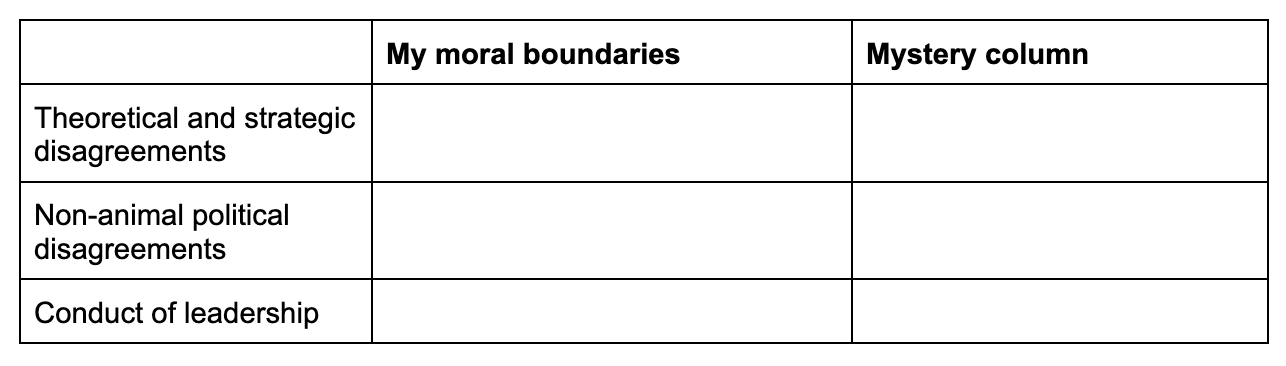
When I try this exercise, I notice that the first two items describe differences in beliefs, which might seem easier to tolerate, while the third describes misconduct. People can hold harmful beliefs if they keep it to themselves, but we can’t allow harmful behavior. Even John Stuart Mill set that boundary. Misconduct is a whole separate category.
Or is it?
Consider some real examples of conduct that has gotten animal advocates fired or even banished from the movement:
Making blunt sexual invitations to numerous coworkers
Dating or asking out people who are much younger than them
Grassroots organizers sleeping with numerous volunteers without setting clear expectations on whether sex would lead to a relationship
Making sexual jokes or discussing their sexual lifestyle (e.g. polyamory) in the workplace
Creating an intensely demanding work culture where employees feared they would be chastised or fired for underperformance
Every item on this list makes me wince. They don’t strike me as examples of wise or conscientious behavior. If someone asked me whether they should do these things, I would strongly encourage them not to, not just because it is risky for them but because I think the people around them and the movement as a whole would be better off.
But how sure am I? Could someone reasonably disagree about whether these actions ought to be acceptable? If I talked to the people in each of these cases, I can imagine them standing their ground. I can certainly imagine a society where sexual jokes are normal at work and everyone is OK with that. That’s not the reality we’re in currently. In our reality, jokes can cause people serious distress, interfering with their quality of life and their ability to get work done. But then, so can being the target of a pressure campaign by an animal rights group. Obviously those are apples and oranges; we might be willing to impose discomfort on a campaign target because winning the campaign would help huge numbers of animals, and telling sexual jokes doesn’t have any comparable benefit to balance out the discomfort it causes.
Further complicating this, each item on that list has plenty of room for gradations and interpretation. How blunt is too blunt for a sexual invitation? Calling someone into your office just as you finish your 1003rd shirtless dumbbell curl is probably too on the nose, but should it be inappropriate to invite a coworker to hang out socially if you’re hoping to see if there might be chemistry?

Jokes are even more ambiguous. I remember a female coworker cracking a joke during a fur campaign when we found out that people in some European countries eat beavers. It was dirty, but nobody thought it was suggesting anything more than that a funny opportunity had presented itself. If a man had made the same joke, would that cross a line? Others in the meeting ran with it and dialed the joke up a bit further over the next few minutes. Each person in the room probably had a different idea of how far would have been too far, and there are probably some people reading this who would have been uncomfortable with any of it.
I suspect that the crux of all this is our understanding of harm. How do we define the boundaries between discomfort and harm, between conflict and abuse, between the political and the personal?
Conflict is not Abuse
“For whoever stays perfectly in line and yet stumbles at just one point has done some real fucked up shit and is guilty of being pretty fucked up.” (James 2:10)
Earlier, I credited John Stuart Mill’s harm principle, the idea that a society should only use its power to interfere with an individual’s self-determination to prevent them from causing harm to someone else. It sounds great in theory, but the centuries since Mill have been embroiled over the question of where “I’m uncomfortable with your lifestyle/beliefs” ends and “Your choices are harming me” begins.
Many misconduct allegations are actually ideological disagreements in disguise. Maybe it’s partly because I know I can’t say I’ve never made an off-color joke, or dated a coworker, or fired someone for underperformance, all with varying degrees of regret. But my intuition still tells me there’s something important in the fact that we don’t rule out every action that causes people discomfort.
For help making sense of that, we can turn to one of my all-time favorite books, Conflict is not Abuse by Sarah Schulman. (If I could get everyone in the movement to read one book, this would be it.) An outspoken progressive activist, Schulman has no shortage of moral clarity. Yet she’s also seen firsthand the consequences of the moralizing tendency in activist spaces.
As the title suggests, Schulman draws a distinction between conflict, where both parties have choice, and abuse, where power is so lopsided that one party can do what they want and the other cannot escape. Her thesis is that society often confuses the two, and activist groups are particularly susceptible. On the matter of discomfort, Schulman points out (emphasis added):
People may feel angry, frustrated, upset. But this does not mean they are being abused. They could, instead, be in Conflict… Therefore the fact that one person is suffering does not inherently mean that the other party is to blame. The expectation that we will never feel badly or anxious or confused is an unreasonable expectation and doesn’t automatically mean that someone else is abusing us. These emotions are part of the human experience.
In the same spirit, the activist Bernice Johnson Reagon said “If you’re in a coalition and you’re comfortable, you know it’s not a broad enough coalition.” Coming together with enough other people that we have a chance of being powerful guarantees that we will not always be comfortable. Discomfort is part of the package.
Our unwillingness to accept discomfort is the main driver behind moral absolutism. Snap judgements and moral condemnations of people with different approaches to life is the easy way out. Moral uncertainty requires us to stay suspended in discomfort without any guarantee that it will resolve. We may feel uncomfortable with someone else’s approach to life forever. We may talk to them about it over and over without ever becoming less baffled about how wrong they are– while they continue to act according to their own views. And that discomfort will be the exact signal that tells us we are building a movement.
The fate of our movement rests on how we choose to respond to that discomfort. Yet currently, the culture of activist spaces has normalized precisely the wrong response. In Schulman’s terms, conflict is the uncomfortable product of differences between two peers, and given their peership, both parties are responsible for addressing the conflict. But when one party can successfully recast conflict as abuse, suddenly all responsibility for their discomfort is transferred to the other. This poisons the incentives necessary for resolving conflict constructively, rewarding the first person to claim victimhood:
Why would a person rather have an enemy than a conversation? Why would they rather see themselves as harassed and transgressed instead of having a conversation that could reveal them as an equal participant in creating conflict? There should be a relief in discovering that one is not being persecuted, but actually, in the way we have misconstrued these responsibilities, sadly the relief is in confirming that one has been “victimized.” It comes with the relieving abdication of responsibility.
A novelist and playwright by trade, Schulman uses anecdotes like this one to invite us to familiarize ourselves with productive discomfort:
I’m at a table with relative strangers. I notice the woman in the opposite chair; she is attractive and smart. Her imagination is surprising. She has insights that are attention-grabbing. And she displays herself in a way that may be aimed at the larger group but is having an effect on me. We are all talking business, but she is a bit naughty. This is a professional gathering inside an institutional building. Yet the woman across the way uses the word “G-spot.” Now, queer people have a sexualized vocabulary in professional spaces that many straight people might find inappropriate, so this stands out as a bit showy, but it’s not that unusual. Later, though, she insists on it. She wants attention for this word and we all give it to her. She smiles, she is bold, she commands but she is also soft in her command. Now I am thinking about her sexually. I am thinking about the word G-spot, its mythologies and implications. The more she insists that we think about this, the more I begin to think about penetrating her and I am also thinking about her penetrating me. Is she flirting with me? I am the stranger here; the others are her workmates. I don’t know if she is always like this, if she is flirting with someone else at the table, or if this is for my benefit. Is this “inadvertent” or is it “intentional.” Is she innocent of being sexually suggestive or is she guilty?
A different person, perhaps one with a history of a specific kind of sexual abuse, processed in a specific way, especially if it pertained to suggestible language, could find her speech inappropriate and upsetting. They could find it harassing. It could be a “trigger.” However, I find it inviting. I am enjoying her and I am appreciating her. If I attempt to follow up in order to discover if this was actually aimed at me, I too could be seen as a harasser; after all, this is a professional relationship. Human Resources could be called in to hurt me. Or, just as easily, my interest could be reciprocated. I have to be very, very careful. One false move and I could be the sad object of an outraged story on the dreaded grapevine: “Sarah Schulman came on to me. It was so inappropriate.” The story would never be “I liked her, I flirted with her, she understood me, and then I was scared I would be hurt like I have been before.” Depending on her character, self-concept, history, and logic, depending on how she chooses to act, or if she is conscious enough to have choice, I could be accused of desire. And so could she. Given the institutional setting, I could even have charges brought against me. Or, things could go very well…
There have been times in my life when I was attracted to someone and didn’t want to admit it, or that I was attracted to or even in love with her, or at least loved her, and had no awareness of this. It is not that I was lying, but that I was defended. I blocked access to my own real feelings. I did this to defend a story about myself that I felt safe maintaining, even if it wasn’t true. But sometimes the other person saw the truth that I was unable to access or be accountable for. Part of peace-making is acknowledging that we can’t know everything about ourselves, and sometimes we reveal things to others that we are not ready to accept…
Of course, people come to themselves in their own time, but what if the denial manifests in something harmful to the other person? What if I was flirting but didn’t realize what I was feeling and doing? What if she responded? What if I became angry or withdrawn at her recognition of a truth I could not recognize? What if I blamed her and asked her to carry the burden of my own dishonesty? What do we call that? Of course, I should not feel expected to kiss someone I don’t want to kiss. But what if I don’t want to want to kiss her but still want to? Then is the other’s forward response an invasion? I don’t think so.
Rumors
In a recent conversation with a close friend in the movement, I had a chance to observe the all-too-human impulse to resolve the discomfort of moral ambiguity using judgement. A third friend of ours was the subject of a rumor spreading in his local activist community about a short-lived romantic relationship. It was a textbook case of misunderstanding and miscommunication between two adults, not unlike Schulman’s example above. But as rumors tend to do, it had grown meaner through elaboration as it circulated. Even still, the most serious version of the rumor didn’t involve any violation of sexual consent, just a comment people saw as distasteful.
The two of us were lamenting the stress it was causing our friend to have a cruel rumor spreading about him. Then, to my surprise, she issued a sharp condemnation, describing his words as “pretty fucked up.” The two of us had heard his side of the story, and it was so clear to me how his innocent, well-intentioned words had led to a spiral of misunderstanding. I was confused at how our interpretations were so mismatched, but as I sought to understand my friend’s perspective, I found myself focusing on a different question: why did she feel a need to take a moral position on a private romantic disagreement at all? She didn’t think the man should be unwelcome in the movement, but she still felt compelled to judge his actions.
I learned that for her, the crux was that the woman in the relationship felt disrespected because of something the man said. She felt it would be disloyal to her gender not to take the woman’s side, since she could easily imagine herself feeling the same way. Schulman’s words echoed in my head: the fact that one party feels uncomfortable does not inherently mean the other party has done something wrong. Discomfort with other people is part of the human experience. And our inability to accept that discomfort leaves us addicted to moralizing.
Folks advocating for cancellations often say that removing people with wrong views or behaviors makes the movement stronger, because those transgressions drive more activists away than any one activist is worth. Essentially, the discomfort caused by having to coexist with people with very different approaches to life is making our movement weaker. I agree completely; that’s the exact problem I’m trying to address. But I believe we will never cancel our way to a movement where everyone feels comfortable. As soon as we’ve closed the circle a bit tighter, people will find new things to disagree about so strongly that they can’t feel comfortable with one another– the narcissism of small differences guarantees it. Indeed, these disputes get more intense as the group gets more ideologically homogeneous.
One way to solve this would be via a diversity of cultures at different organizations. There could be some orgs where people can relax knowing they won’t hear inappropriate jokes that cause them distress and distract from their work, and others where different people are free to bond with their fellow activists over raunchy humor. This sounds nice in theory, and already happens informally to some extent; volunteers and employees alike choose organizations partly based on cultural fit. But we can only subdivide this so finely while still being able to match people’s skills to the organizations where they are needed– and the narcissism of small differences will still rear its head.
The Boy Who Cried “Immoral!”
“If you avoid majorly fucked up shit, we’ll forgive the little things.” (Quran 4:31)1
I’m not calling for us all to become complete moral relativists. Without moral clarity, we can’t fight against animal exploitation. And I deeply wish for every activist that they can find an organization where they feel respected by their fellow activists, whatever that means to them. So how can we build a movement for animals without constantly condemning each other?
We could give a utilitarian answer. There are movements for other marginalized groups; animals deserve one too. Such a movement is more likely to win if it’s focused, has as many allies as possible, and doesn’t get divided over other issues, however important they are. We should plug our noses and work with anyone who is willing to help animals. People who want to speak up for other issues in addition to animals should direct that energy into other movements rather than trying to purify the animal movement. After all, the animal movement doesn’t even have enough power to win on its own issues, so why does it matter if it is perfectly aligned with all the rest of our ideals?
This is a reasonable way to argue for tolerating moral disagreement within our ranks. But I worry it’s an unstable arrangement, and I think we can do better. We’ve acknowledged that a line has to be drawn somewhere; let’s not defer the question any longer. We’re looking for a coherent moral boundary where we can say, “Cross this line and I will fight you. I will raise up a movement against you. Stay outside of that line, and while I may be deeply uncomfortable with your actions, I will accept my own moral uncertainty.”
A clear, narrow boundary would sharpen our moral clarity, both internally and externally.
Internally, focusing on a narrow moral boundary would spare us from constantly relitigating ambiguous moral questions. Instead of repetitive debates about whether someone’s dating choices disqualify them from leadership and factional splits over political disagreements unrelated to animals, we could channel all that energy toward winning.
Externally, conserving our moral energy makes our condemnations more credible. We could call this the law of the conservation of moral credibility: when you dish out moral outrage too liberally, people stop taking any of your convictions seriously, learning to see you as someone who only knows how to shout no matter how nuanced the issue is.
We’ve seen this play out very clearly in the last decade. In the name of fighting racism and sexism, progressive activists sought to bring down public figures they saw as guilty of insensitive comments. Energized by a number of successful takedowns of political opponents, some activists pressed on, seeking to define a broader and vaguer set of statements as disqualifying, and extending their criticism past powerful political figures to target comedians for misunderstood satire and even ordinary people for parenting choices. (If you reject that those two examples are representative of a broader trend, I don’t know what to say; we’ve clearly been living in different worlds.)
The general public came to see these condemnations as reflexive—activists crying wolf over and over again. Eventually, they stopped listening entirely. This left the Overton Window wide open for genuinely racist views to stride into the mainstream. Trigger-happy cancellations placed the progressive movement in no position to respond with integrity when elements of the right went on a cancel culture rampage of their own, getting regular people fired for daring to question Charlie Kirk’s politics in the wake of his killing. The boy who cried wolf didn’t just lose credibility for himself; he left the village vulnerable to actual wolves.
If I’m being honest, the conservation of moral credibility has an effect on me as well. When I sense that someone’s political views adhere perfectly to the consensus platitudes of the college campus left, a voice in my head says they must not really be thinking for themselves. And when they react with indignation to even the slightest deviations from those platitudes, I have to resist the urge not to roll my eyes, such as when my (cis male) housemate gets into an argument with his boomer dad about whether “they” is a grammatically correct single-person pronoun. I think the dad’s argument is dumb and unfounded, but I also think my roommate’s decision to pour energy into that disagreement is missing the point and weakens his overall credibility.
The animal movement exists inside these broader dynamics, but we could choose to rebuff them. When we treat every moral disagreement as disqualifying, we dilute the power of our condemnation. When everything is an emergency, nothing is.
Violence and discomfort
“If we claim to have never done fucked up shit, we deceive ourselves and the truth is not in us.” (1 John 1:8)
If I haven’t lost you, then at this point, we’re looking for a sharp, narrow moral boundary for animal activists that allows us to come together across differences and fight against the most important injustices while conserving our moral credibility. In other words, we’re looking to separate conflict from abuse. When people, groups, or ideas are in conflict, we want to learn to accept discomfort and uncertainty while we search for compromise solutions. But when someone is being abused, we will step in with a strong, clear “No.”
Where do we draw the line? Let’s start with what we know for certain: factory farming requires extraordinary violence against defenseless beings: forcing someone into a cage for their entire life, mutilating their body without anesthesia, and then violently killing them. These are beings who cannot defend themselves, organize resistance, or escape. They’re completely at our mercy, and we’re showing them none.
Our boundary can start with violence: forceful confinement, mutilation, and killing of beings who can’t defend themselves.
The extremely bad news is that we could spend the rest of our lives fighting against abuses in this category and likely not come very close to eliminating them. The United States government is addicted to war, constantly bombing and invading some of the poorest countries on Earth and dragging most other Western governments along with it. As I write this, Israel has been trampling over a ceasefire and seems likely to fully resume its indiscriminate slaughter of civilians trapped in Gaza any day now, with weapons provided and paid for by the U.S. and its allies. Swarms of ICE agents across the U.S. are shooting, beating, and kidnapping immigrants and citizens alike. Vast numbers of downtrodden Americans are watching their lives drain away inside hellish prisons for ridiculous “crimes” like possessing psychoactive plants people wanted to consume voluntarily. And, of course, factory farming is in the midst of a massive global expansion.
I doubt anyone thinks that the boundary around violence defined above encompasses every problem in our society. Personally, I have plenty of other convictions about the nature of other social ills. But my degree of certainty in diagnosing them, my sense that reasonable people could not disagree, falls off rapidly as soon as I step out of that boundary.
People with more power can coerce people with less without using or threatening physical violence. Blackmail, coercing people by threatening to fire them, sabotage their career, or expose private information, should have no place in a decent society, and indeed, these are thoroughly illegal. We could try to extend our boundary to cover coercion by means other than violence. But we quickly run into thorns. The state uses the threat of fines and license revocation to coerce freelance professionals into providing service to customers those individuals might wish to discriminate against, such as the famous case of Masterpiece Cakeshop, a baker in Colorado who refused to provide a custom wedding cake for a gay couple and was nearly forced to shut down his business over it. While that case provoked controversy, few people today argue that a photographer should be allowed to refuse to work a wedding for an interracial couple.
Of course, seeking to get someone fired for telling inappropriate jokes or asking out too many coworkers is itself an act of coercion (using the same lever of professional consequences), as is nonviolent direct action to block ICE facilities, pipeline construction sites, or slaughterhouses. The progressive analysis of these examples would be about power dynamics; bosses have power over their employees, while gay couples trying to get married are in a marginalized position relative to straight couples. But coercion only works if one side is able to marshal enough power to force the other side’s hand. I enthusiastically support anti-discrimination laws, but I wouldn’t try to tell a baker with deeply held Christian beliefs that he was in the power-up position when the state is forcing him to make a cake for someone’s gender transition party; I’d just tell him to take the L this time and make the damn cake. Discomfort with other people, including customers, is the cost of living in modern society.
I have to take several steps further out of our narrow boundary to get to some cases that have divided our movement. Consider one case of a leader in his late thirties dating a subordinate coworker in her early 20s. Many saw this as a straightforward abuse of power, arguing (despite her objections) that true consent was impossible given the power imbalance. I was certainly uncomfortable with it. But, she was an adult. She could leave the relationship at any time; eventually, she did break it off, and faced no punitive consequences. Years later, she still rolls her eyes at the concerns I and others expressed at the time, making it all seem rather paternalistic.
It’s certainly possible that a relationship with similar details could involve manipulation or emotional harm. A manager of any age explicitly or implicitly leveraging workplace advancement in exchange for a sexual relationship seems clearly across the line. Our legal system already enforces some very reasonable boundaries here; workplace sexual harassment has a legal definition that attempts to balance a fraught situation. The law also sets a historically high age of consent, and while it allows for age gaps that make me squirm, trying to define a better rule gets messy fast.
Side note: proponents of cancel culture on the left tend to reject the idea of getting police and courts involved in allegations of abuse, sexual or otherwise, partly because the legal system can be traumatizing for victims of genuine violence and abuse, but also because leftists theoretically reject the punitive approach to justice embodied by our current system. In practice, however, the same people are quick to wield ostracization in a punitive manner against people accused of misconduct. The unwillingness to process allegations through police and courts only has the effect of removing any right of due process, standards of evidence, or even opportunity for the accused to present their side of a story. While I doubt the solution is for activist communities to turn to police and courts more often to resolve conflicts, there has to be some effort to recreate the best qualities of that system.
What about a leader I know who has been criticized for an intense, demanding work culture where employees fear being fired for underperformance? Some would call this abusive. But the employees can quit, and most of them would probably be able to get higher-paid jobs outside animal advocacy without much difficulty. They’re not locked in cages. This might be a shitty management style– or it might be effective. It’s hard to imagine a results-oriented workplace where no employee ever feels their boss expects too much of them. I don’t know whether this leader is fucking up or not. What I do know is that it doesn’t belong in the same clearly-defined moral category as factory farming.
Lastly, we have the range of conservative-leaning political views on issues unrelated to animals. Animal activists come from all walks of life. Some believe immigration should be more restricted, are skeptical of progressive views on gender, or believe strongly in the merits of free-market capitalism. These are all views held by a majority of the American public, yet I’ve seen calls for activists to be banished for each of them.
I have my own opinions on most political issues, including some I hold very strongly. I’m not confident enough in any of them to exclude half the country from working on behalf of animals. Even if there were one or two I felt that way about, I have the presence of mind to realize they probably wouldn’t be the same one or two as everyone else. If we default to letting anyone dictate the acceptable political boundaries of animal activists, we’ll end up with a tiny, insular group faster than you can blink.
The animal movement doesn’t need to resolve every political dispute in America before we can work together to end factory farming. On the contrary, we need to learn to accept vast differences if we’re ever going to achieve that goal. We shouldn’t accept physical violence or coercion. And you don’t have to approve of everything outside that boundary. You can still wish your colleague managed their team differently. You can still disagree with someone’s political views or question their dating choices. And you can state your views on all of those things clearly and unapologetically. But you accept that you might be wrong, and you don’t make these disagreements into movement-splitting issues.
This is a high bar for moral certainty, and it should be. Because every time you draw a moral boundary and exclude people for crossing it, you’re making the movement smaller and weaker.
The price of division
“For what does it profit an activist to gain moral clarity, yet forfeit ten million chickens?” (Matthew 16:26)
For years, I wore a long, totally unmanaged beard, resulting in an appearance nobody would call ‘professional.’ I was leading a small animal advocacy org, and various people tried to convince me that cleaning up my appearance would cause me to be taken more seriously by funders and politicians. I was resistant, until finally someone I looked up to presented the question differently:
How many chickens would have to be saved for it to be worth trimming your beard?
The implication was obvious: if you believe that the work you’re doing in this movement has any impact whatsoever, that impact is measured in lives. Any slowdown or inefficiency is measured in lives, too, likely by the thousands or millions. Our work is a matter of life and death. Being one day slower to end factory farming would amount to tens of millions of tortured lives. If my long, disheveled beard even had a chance of putting a dent in my effectiveness as an advocate, then I was basically prioritizing that over the animals I said I was trying to help.
Let’s come back to the table from earlier about our moral boundaries within the movement. We’re ready to fill in the third column. You know what it’s going to say:
How many chickens would you be willing to kill to uphold that boundary?
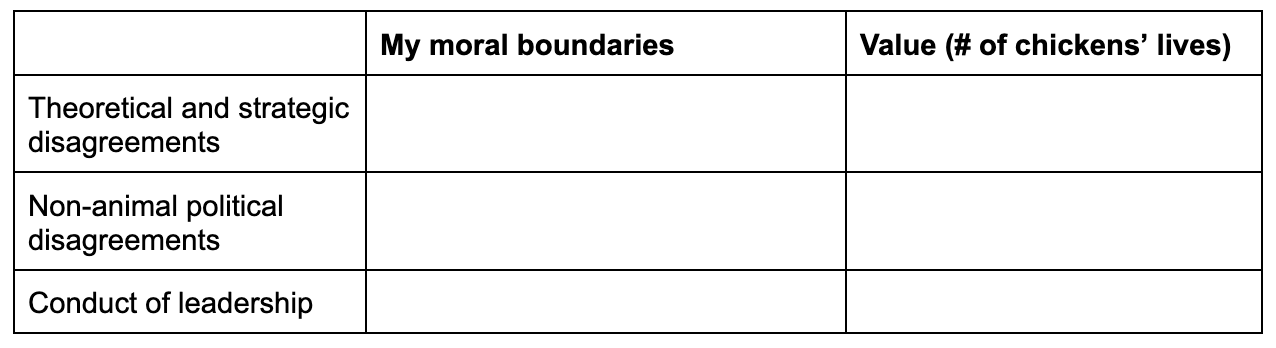
Proponents of cancel culture in the animal movement object to this framing, describing it as an attempt to silence criticism by weaponizing animals’ lives. I think silencing criticism is a bad thing. But also, this framing seems to me to be straightforwardly true, and responding truthfully to criticism is a good thing. This logic convinced me to start trimming my beard, and it changed my approach to moral disagreements with other activists.
I’m very sure that breeding chickens into a lifetime in factory farms is bad. I wouldn’t say I’m 100% certain, but I’m more than certain enough to act on it. I would only kill a chicken to defend a value that I think is even more important. To me, that clearly means directly stopping something even more harmful. Preventing animal activists from ever feeling discomfort with their fellow activists’ views or actions, insofar as those actions are not illegal, seems both unattainable and unworthy of this cost.
Moral Progress
“I am convinced that nothing is fucked up in itself, but if anyone regards something as fucked up, then for that person it is fucked up.” (Romans 14:14)
The very term progressive reflects a common view of history that moral progress trends slowly but surely upwards. Starting at least with the abolition of slavery, we’ve been leveling up our moral condition one issue at a time.
Animal advocates should be naturally skeptical of this view; for the last century, the world has been getting worse and worse for animals, and the trend shows few signs of reversing on its own. The enormous suffering caused by the spread of factory farming is more than enough to outweigh all the gains we’ve made to human wellbeing. While some forms of animal cruelty have gone out of vogue, these changes have been driven by technological rather than moral progress; hunting whales was made obsolete by cheaper lighting fuels, whipping horses by internal combustion engines. Even the public’s squeamishness about factory farming is mostly a product of agricultural work being automated to the point that most of them never set foot on a farm.
The earliest movement to call itself progressive was focused on spreading European and Christian lifestyles to colonized peoples, often using deadly force. They were certain they were advancing humanity’s social and moral condition. Modern activists would forsake any association with these thinkers. But it isn’t outrageous to see them as the progressives of their day, relative to mainstream imperialists who were content seeing the colonized as soulless heathens not worth the trouble of preaching to, slaughtering them even more callously in the rush to plunder their natural resources. (It fell to classical liberals like Bentham to criticize the colonial project altogether, further highlighting the fluidity of these terms over time.)
Understanding how moral attitudes change over time wouldn’t just improve our strategy; it could also help us treat each other with greater humility. Historians often question the view that society progresses over time due to advancing morals. One of my favorite examinations is by Professor Ian Morris in his book Foragers, Farmers, and Fossil Fuels. An archaeologist by training, he demonstrates a rare ability to shift between a short-term view of human history where individual agency is paramount, and a long-term view governed by vast, impersonal forces.
Morris puts forward a materialist explanation for moral patterns across different societies. The main changes he sees depend on the way a society extracts energy from its environment. The earliest humans extracted energy by hunting and gathering, and the most successful hunter-gatherer groups were deeply egalitarian (and still are to this day.) Attempts to impose hierarchical domination simply don’t work in this context, so over time, foragers come to believe that egalitarianism is the correct way to live.
Then came agriculture, a radically different way of extracting energy. Farming societies made it possible to generate surplus, especially by managing greater complexity– irrigation, roads, eventually ports. People who could achieve these on larger scales using hierarchical organization flourished, and eventually, the meaning of fairness changed. From Morris:
If you’re a hunter-gatherer, “fairness” means treating everybody the same. In a farming society, fairness means recognising their differences. You’ll say, “The Pharaoh of Egypt is so rich, so powerful, that only a complete idiot would say the Pharaoh is the same kind of animal that you and I are… Common sense tells us the Pharaoh is a god.”
The material conditions of farming societies gave rise to slavery, the subjugation of women, and a worldview that rationalized both. Almost every society on earth functioned this way for 5,000 years, until humans unlocked the energy stored in fossil fuels. What had been universally seen as natural (slavery, sexism) became unthinkable within two centuries, not because humans suddenly tapped into universal moral truth, but because different forms of social organization became more productive. Industrial technology gave rise to new societies that benefited from a larger, more educated workforce, and those countries that pulled women out of restrictive domestic roles and instituted universal education quickly outcompeted those that failed to update their morals.
Liberalism, democracy, and market capitalism became the dominant moral frameworks of the industrial age. Today, all of these are being challenged. The transition to solar and nuclear energy is being driven by illiberal China, just as faltering liberal democracies in the West flirt with authoritarianism. A new age of high automation might give rise to a totally new set of values, and they may not be what we expect or want.
It’s clear from his writing that combing through the historical evidence for these shifts has instilled in Morris a deep sense of moral humility. Here’s what he had to say about it on the 80,000 hours podcast:
…if we’d been having this conversation 300 years ago, and I had told you about the upcoming industrial revolution — and how this was going to mean that your wife was going to go out to work, and you weren’t going to be able to enslave anybody anymore, and Jews were going to own stuff — I would bet you dollars to doughnuts you would’ve been offended by what I said. Because if you were a perfectly normal early 18th century British person, this would’ve been horrifically offensive to you. And it’s easy to think of a comparably offensive thing that somebody might say now. Because we don’t see the future, we don’t know how the world is going to change. It would be impossible for you to imagine the world that the industrial revolution produced, and equally impossible for you to imagine how you would react if you time travelled forward and settled down in a post-industrial world.
Anthropologists are useful people to read on this, because a lot of what you do as an anthropologist is clear off and go and live in a society that is often fundamentally different from the one that you live in. When I was doing archeological fieldwork, I spent a lot of time in the south Mediterranean, in Greece and Sicily, where the value systems there are much more like a traditional farming value system. Not like a mediaeval farming system, because of course, Sicily is highly fossil fuel driven, and they have electricity, they have cars, all these things. And yet, as we all know, the farming parts of all countries tend to be more conservative, more traditional.
And these were people who were rabidly sexist, were, to my mind, offensively racist. Had all kinds of just horrible attitudes about all kinds of things. Yet they were great people; they were wonderful people. I loved spending time with them. And I guess I have a sufficiently low opinion of my own moral backbone that I think that if I were dropped back in the Middle Ages, my personal values would be more or less what we see from actual mediaeval people. If they were brought here, they would probably have the sort of Western post-everything weird values that I have.
I think that’s what we are. We are very malleable animals. We can transform ourselves because we are good at recognising the costs and benefits of the context that we’re in. Which I know sounds very cynical, but it’s where evolutionary thinking leads to. It doesn’t mean that you have to like it. I like my values, I enjoy them. I would hate to be a different person. And yet as I see it, it’s a matter of, do I have a broad enough perspective on the world to understand that what I perceive as my own excellence is not entirely my own doing? It’s because of the context I find myself in.
Modern humans evolved in small bands hunting and gathering in a vast, hostile wilderness. We’re all just foraging monkeys who’ve been dropped into a frantic, high-modern society and asked to confront moral questions evolution never prepared us for. If our moral attitudes differ from people in medieval times, it’s a consequence of the world we’ve grown up in, and due to no fault of our own.
I’m not advocating for complete cultural relativism. Taking a classic example, female genital mutilation (FGM) remains a common practice in some rural communities across many parts of Africa. It is usually performed by women, sometimes by force but often with the nominal consent of young girls under pressure from their mothers and grandmothers, recreating their own traumatic childhood experiences. Through the end of the 20th century, the debate over FGM among global development scholars explored the limits of cultural relativism, with some arguing it was not the place of Western-dominated institutions like the UN to intervene in local customs. This strikes me as deeply misguided. In principle, I enthusiastically support efforts by Western charities to end FGM. (Tractability has proven a different question, which is upsetting to think about.) Culture is not a blanket excuse for harm and should not be used to cover for spousal rape or mutilation of girls too young to consent.
That’s the hill I’m willing to die on: coercive violence by the powerful against the weak. And I know that if I choose too many more hills to die on, I’ll probably just die, figuratively.
Which means animals will die literally.
Choosing the hard way
“For all have done fucked up shit and fall short of the glory of Political Correctness.” (Romans 3:23)
Moral uncertainty requires courage. When we see people moving through the world according to different values than our own, we feel discomfort. Judgement, condemnation, and punishment are the easy way out of that discomfort. The courageous path is to tolerate those differences even if the discomfort never resolves.
A moment ago, I proposed that there exists a law of the conservation of moral credibility: people who too liberally dispense moral outrage squander it. But that is only half of the law; moral authority can also be lost through silence. People who would hold themselves up as moral role models yet stay silent when presented with the realities of factory farming or their government’s genocidal military campaigns lose their credibility at least as quickly as overeager activists.
Sarah Schulman addresses this flip side clearly in Conflict is not Abuse. Her thesis is that our society consistently overstates harm from conflict, but just as often understates real violence and abuse. We gawk at tabloid headlines detailing the latest celebrity feuds and extramarital affairs while shying away from understanding the “complicated” histories behind lopsided wars of extermination fueled by our own taxes.
The conservation of moral credibility calls for us to stand firmly against abusive atrocities, and at the same time approach ambiguous conflicts with humility and uncertainty. How are we supposed to strike this balance? Here’s the truth, reader: you won’t. You will fail to be a perfectly calibrated moral agent. You can’t let that immobilize you, but you can choose to approach your activism with a kind of grace.
One test I like is: to conduct myself such that if I later realize I was wrong about a certain moral conclusion, I could still feel proud of my misguided actions. We can and should still work towards changing laws and cultural norms that go beyond the narrow boundary of violence (though I choose to focus my energy there.) But we can go about this in such a way that history will look kindly on us even if they judge certain of our conclusions to be badly miscalibrated. I feel embarrassed to think of future generations looking back on why the animal movement didn’t succeed sooner, didn’t save more lives, and finding out it is because we were engaged in constant cycles of infighting over cultural and political debates that seem, to them, parochial.
None of this was obvious to me when I first joined the movement; I learned these lessons the hard way. A few years in, I woke up one morning to find myself carrying a pitchfork in a crusade against other animal activists. My convictions at the time were badly misplaced, and the way I handled them is nothing I can be proud of today. I consider it my greatest mistake, one that I am still working to make up for many years later. But that’s a story for another day.
Neither do I believe the animal movement is a place where other issues should never be discussed. Such a prohibition would be just the opposite of what I am advocating for, especially when we consider who would get to define what counts as “other issues.” Rather, our movement should be an intellectually curious place where political questions can be discussed with humility, in those moments we spend resting and reflecting between fighting like hell for what we all agree on.
Everyone you meet in the animal movement is just a primate from their ancestral environment into this violent, alien society, just doing their best to get by– and that includes you. None of us has the mental equipment to be perfect moral interpreters of this tumultuous world we’ve inherited. We’ll make mistakes, and people around us will make mistakes.
Beyond allies and enemies
How can we rise above the narcissism of small differences and learn to live with the discomfort of moral uncertainty?
My trick for avoiding the alienating shock of discovering small differences with allies is to try to stop thinking of the world as divided into allies and enemies altogether. It’s easy to think of the gameboard as being made up of us, the animal movement, and them, the perpetrators of animal abuse, along with a bunch of unaffiliated bystanders. This has obvious benefits. I know who my allies are, and I can trust them; I can stop watching my back and focus on the struggle against the adversary. That works, until my allies let me down. Of course, your fellow activists won’t think they’re betraying you; they’re just acting out their own different way of being in the world. They never promised you anything else; you took it for granted that you would agree on everything.
If instead you see the world as a chaotic mess of free agents each acting according to their unique values and perspective, you might not get that same warm, safe feeling that you have found your people. But you’ll spare yourself the heartbreak. More importantly, this is how the world really is. We work with others towards a shared objective whenever our values and desires align. These coalitions are temporary and limited. We can either accept that in advance, or set ourselves up for devastating heartbreak later on.
In case that makes the movement feel a bit less beautiful, I leave you with one more story. It’s a story my friend Josh Balk tells about the first time he went undercover in a chicken slaughterhouse.
Josh is a towering figure in the animal movement both figuratively and literally. Between his broad, athletic build and gregarious personality, he tends to attract attention. So he was a bundle of nerves when he showed up the first day undercover, loaded up with 2005-era camera and microphone gear hidden under a thick jacket. It took all his attention to keep his hands from shaking as he stood outside in the early morning chill with the other workers; he already stood out like a sore thumb as the only one passing up the chance to smoke a cigarette.
Finally, the bay doors rolled open, and the foreman directed him where to stand along the conveyor belt of empty shackles. A horn blared, the belt started rolling, and moments later, a flood of white feathers tumbled around the corner. Josh was at the furthest back point on the line, and he watched as workers methodically grabbed the struggling chickens and slid their feet into the moving shackles above.
Finally, a chicken made it past this gauntlet and rolled up in front of him. His heart pounded and the world around him sharpened and slowed as Josh picked up this first chicken, flipped her upside-down, and slid her feet into the shackles. As the belt pulled her away from him towards the sawblade that would slice open her throat, he whispered a simple apology: I’m so sorry.
As Josh tells it, something snapped into focus for him in that moment, something he hadn’t understood until right then: I don’t matter. This movement has nothing to do with me. Compared to this endless stream of tortured and murdered souls, I am utterly insignificant.
The scale of what we are up against is something most of us can’t begin to wrap our heads around, and it isn’t always helpful to try. But I wish every one of us in this movement could have an experience like Josh had, to glimpse that reality. In the face of this horror, I don’t matter. You don’t matter. This isn’t about us, and our abstract political theories don’t matter a scintilla to the billions and trillions of animals in factory farms.
This movement isn’t about theories. It isn’t, ultimately, about creating a welcoming community where people with the right politics feel warm and fuzzy. It’s about winning for animals. I hope that’s one thing we can all be certain of.
Build on,
Sandcastles
Mantras:
Moral uncertainty requires courage.
The more similar we are to someone, the less willing we are to tolerate disagreements.
Many misconduct allegations are actually reasonable ideological differences in disguise.
If you’re in a coalition and you’re comfortable, you know it’s not a broad enough coalition.
The fact that one party feels uncomfortable does not inherently mean the other party has done something wrong. Discomfort is part of the human experience.
Stop thinking of the world as divided into allies and enemies.
I don’t matter.
I wanted to use a more even mix of Biblical and Quranic passages, but it seems the Quran is much less harsh about sin than the Bible (and animal activists, apparently) ↩︎