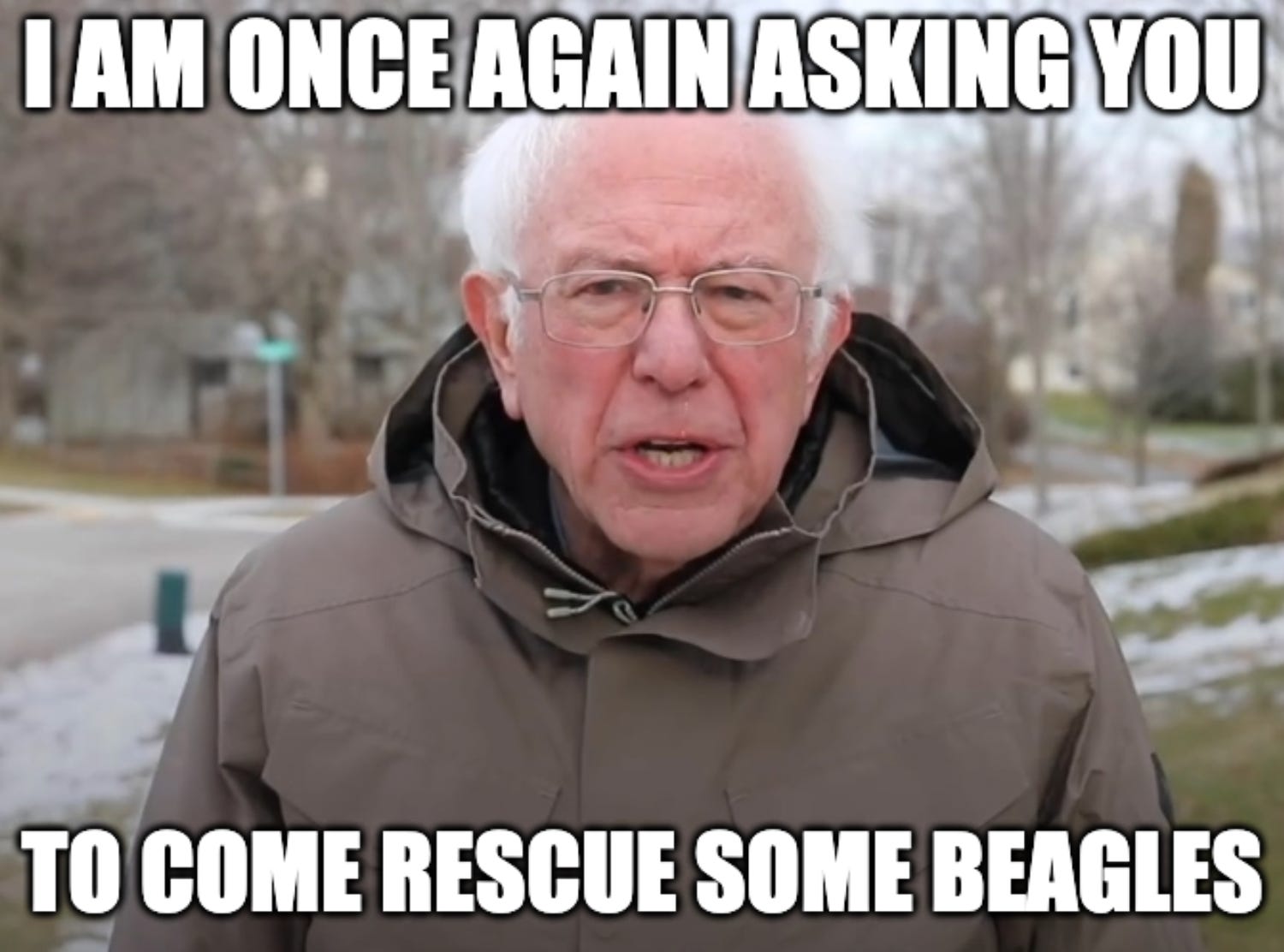
I am once again asking you to come rescue some beagles
This is a once-in-a-generation moment for animal rights. Don’t miss it.
tl;dr: please join me and 2,000 other people in Wisconsin on April 19 to tear a Beagle farm apart brick by brick and rescue every one of the 2,000 dogs still languishing inside. Sign up to join the action here and RSVP to our next zoom briefing this Saturday at 1p ET.
Listen reader, I know you’re busy. I’m pulling you away from doing amazing work for animals, right now. So I’ll keep this short.
You’ve spent years grinding away in the animal rights movement. Yet you don’t have much to show for it besides your battle scars. Public opinion hasn’t moved much. Veganism is out of fashion, and the alternative protein sector has stalled. The fur industry came back from the brink. Our most-hyped victory, removing battery cages in the egg industry, still hasn’t crossed the 50% mark of the U.S. flock.
Yet you have found it inside yourself to toil away year after year. Partly that’s because even if we can only ever help a small fraction of farmed animals, there’s nothing more important you could be doing with your life.
Subscribe below if you like weirdly accurate analysis of your animal activist psychology from a complete stranger.
But that’s not all. Somewhere deep down, you manage to stay on your feet because of a glimmer of hope. Hope that if we keep at it, someday things might feel different. Our movement could go mainstream. We could leap out ahead of incremental reforms and bring entire industries tumbling down with the sudden force that toppled Jim Crow and marriage discrimination.
I’m not going to tell you this is that moment. But it’s the closest we’ve come in my decade of activism.
Beaglemania
On March 15, around a hundred animal activists stormed a dog factory farm in Wisconsin, where beagles are bred before being shipped off to torture and death in research. 23 dogs were brought to safety, out of 2,000 in the facility, and 27 activists were arrested but only after demanding to be arrested for nearly two hours, as freezing rain dumped down on them and the police officers alike.
Day of, the action felt like a big success. But none of us had any premonition this would blow up the way it has. Through some combination of rescuing dogs instead of chickens, building on an 8-year courtroom saga, a celebrity arrest (Baywatch star Alexandra Paul), and sheer random luck, this action has captured the imagination of journalists and the general public. In the first five days after the action:
Coverage from CNN, Washington Post, and USA Today garnered tens of millions of views on TikTok and Instagram.
30,000 people signed up to get involved in the campaign.
Dave Portnoy of Barstool Sports, Hollywood director James Gunn, and other high-profile influencers with no prior connection to animal advocacy have endorsed the rescue.
I don’t think those bullets do a good job of conveying the energy around this. Our movement has had viral videos before. We’ve had coverage in the inside pages of the New York Times before. We’ve had viral petitions that get tens of thousands of email addresses. Yet I feel confident that this is qualitatively different.
Rather than frantically try to convince you, I propose an experiment. My hypothesis is that the Ridglan raid has triggered a moment of the whirlwind, a once-in-a-generation trigger event for pushing animal advocacy into the mainstream. If that’s correct, I think we should be able to channel it into the largest—by number of participants—act of nonviolent civil disobedience for animals since the 1990s.
The experiment will take place on April 19. We’ve invited all of those 30,000 signups to join us returning to Ridglan. We will ensure every dog still at the facility is brought out safely to a loving home. And we’ll use the resulting momentum to pressure RFK’s HHS to end all federal support for animal testing.
There’s just one problem, reader: you and I are not disinterested observers of this experiment. We both desperately want it to succeed. Our ultimate goal is not understanding the mechanisms of social change for its own sake, but making the world better for animals.
So we’re going to contaminate the experiment by doing everything we can to get the outcome we want. I’m going to urge you to come, you’re going to come, and we’re going to make this the moment we’ve all been waiting for.
17,042,001 Reasons to come to Ridglan
I know what you’re thinking, reader. You think you’re so unique, but I see you. You’re thinking, “this sounds great and all, but if there are already 2,000 people going, what difference does it make if I go? Shouldn’t I focus on my other effective work for animals?”
Sorry, but that’s not how this works. Let me explain by offering some reasons you specifically are needed.
Reason #1: The Self-Sampling Assumption
Imagine you wake up inside of a box. A phone rings inside the box, and you pick it up. On the other end of the line, you hear my voice, explaining that I’ve knocked you out and put you inside of this box. But before I did it, I flipped a coin. If the coin landed heads, I would do this to you and ten other people, each in your own box, and label the outside of the boxes #1 through #11.
But if the coin landed tails, I would do the same thing to you and ten thousand other people, labeling the boxes #1 through #10,001. In each case, I’d assign you and everyone else to boxes randomly.
I invite you to place a bet: if you guess correctly how the coin landed, I’ll pay you $1,000. Before you get out of the box, this is hard: you should think there’s a 50/50 chance I kidnapped 10 people or 10,000.
Now, however, I unlock your box. You step outside, and see that your box is labelled #7. And I give you a chance to change your bet. Should you update your bet to favor the coin landing heads, and only 11 people being inside 11 boxes?
Clearly, you should! It’s very unlikely that you’d be randomly assigned to one of the boxes #1 through #11 if there were 10,000 boxes, so this is significant evidence that there were only 11 boxes to begin with.
This illustrates an idea from philosophy called the self-sampling assumption, and I never thought I’d be using it to try to persuade someone to come break into a factory farm and rescue beagles. But it actually makes a ton of sense! Let’s apply it to our situation.
Imagine there are two possible worlds. In one of them, 2,000 people show up to Ridglan, rescue all the dogs, and successfully pressure RFK to end federal support for animal testing.
In the other, only 100 people show up, the same number as last time. The police arrest all of us, laughing maniacally the whole time about how evil has triumphed again.
It might not seem like you alone make the difference between those two worlds. But actually, the Self-Sampling Assumption proves otherwise. Since you are just one person, it’s 20x more likely that you would attend the Ridglan rescue in the world with 2,000 rescuers than the world with just 100. By choosing to attend the rescue, you step out of the box and reveal to yourself that you live in the world with 2,000 rescuers, thus saving all the dogs. You are able to acausally influence 1,900 other people’s behavior with your one choice!
The other reasons
OK asshole, that’s the only special reason you get. Reasons number 2 through 2,000 are the beagles currently spinning in circles hour after hour inside their cage at Ridglan Farms where they never see the sunlight or touch grass before some untrained sociopath cuts into their face with a scalpel and no pain relief whatsoever.
Reasons 2,001 through 42,000 are the rest of the beagles used in animal research each year. And reasons 42 thousand through 17 million are all the other animals used in research. (The number is highly uncertain; 17 million is the low end estimate, 111 million is the high end.)
Yes, these numbers are smaller than chickens and fishes raised for food. There are already whole big organizations focused on rescuing dogs from animal testing, and they get way more funding than the entire ecosystem of groups working for vastly more numerous animals farmed for food, not to mention wild animals.
Yet none of them managed to shut Ridglan down. Instead, Ridglan is closing down their breeding operation on July 2 because of a scrappy team of radical abolitionist activists who snuck in one night in 2017, took some footage, rescued two dogs, and published their investigation openly. They were charged with felonies, but tried their case so effectively they were able to flip the tables and get a judge to appoint a special prosecutor to investigate Ridglan! The big dog and cat rescue orgs were never going to do anything like this.
You might be skeptical of social movement strategies in general. There are people who’ve been calling for a mass protest event for animals every year since forever. They’ve correctly predicted ten of the last zero mass protest events for animals. Wayne Hsiung is the most notorious of them all, and he is the guy leading this Ridglan thing too.
But wait: this time it actually is happening! We’ve already had 1,200 people commit to actually join the action at Ridglan on the 19th. Half of them say they are willing to take felony-level risk to get the dogs out of Ridglan. That’s already enough to set records.
Most of these are normal, omnivorous dog lovers who’ve never been part of animal activism before. And the momentum is only growing. Top national news outlets are dropping feature stories in the coming days, and in the weeks until April 19, we have A-list celebrities hosting zoom calls to promote the campaign.
I totally understand not wanting to spend all your animal activist energy on desperate bids to trigger a mass social movement episode. But that’s a separate thing entirely from not showing up when the moment finally comes. Skipping this action because you don’t believe in mass social movement organizing would be the opposite of the experimental contamination I propose above– you’d be sabotaging a generational opportunity out of spite for the theory of change behind it.
So just come. It’s one weekend. What could possibly be a better use of your weekend than storming a dog torture factory with 2,000 new friends, causing front-page national news, and finding out just how far we can take this thing?
Sign up now, and I’ll see you in Wisconsin.
Build on,
Sandcastles
If you share the post, then so will everyone else who receives it, and we’ll get 5,000 people instead of 2,000.
Build on, Sandcastles