We Got Our Asses Kicked. It Worked.
Now that the Ridglan dogs are free, Wayne should stop apologizing.
I wrote this whole post Monday on the assumption that we had a tough political fight ahead of us to finish off the campaign against Ridglan, a beagle factory farm in Wisconsin. As I was applying the finishing touches, an old friend called me to tell me otherwise: the Ridglan dogs are—as you read this—safe and on their way to loving homes. A separate coalition of dog rescue groups paid an undisclosed amount of money, rumored to be around 25% of their list price, to buy out the farm and permanently shut it down.
This changes everything, and also nothing. Read the post knowing I wrote it without that knowledge, and decide for yourself whether it vindicates me. I have added a bonus section at the end sharing what I’ve heard about the negotiations to buy the dogs and my current feelings about buying out animal abusing businesses.
Lastly, in case you were gearing up to spend the next ten weeks fighting like hell to get those 2,000 dogs out of Ridglan, well, now you don’t have to. But there are still millions of animals languishing inside vivisection labs and fur farms, and billions in factory farms. Our work is nowhere near done. So take all that energy you were gathering and:
Take urgent action TODAY to stop the worst federal law ever proposed for animals.
Join me in Washington DC May 15-17 for the Grassroots Animal Rights Summit, featuring some of the most effective campaign organizations in the movement.
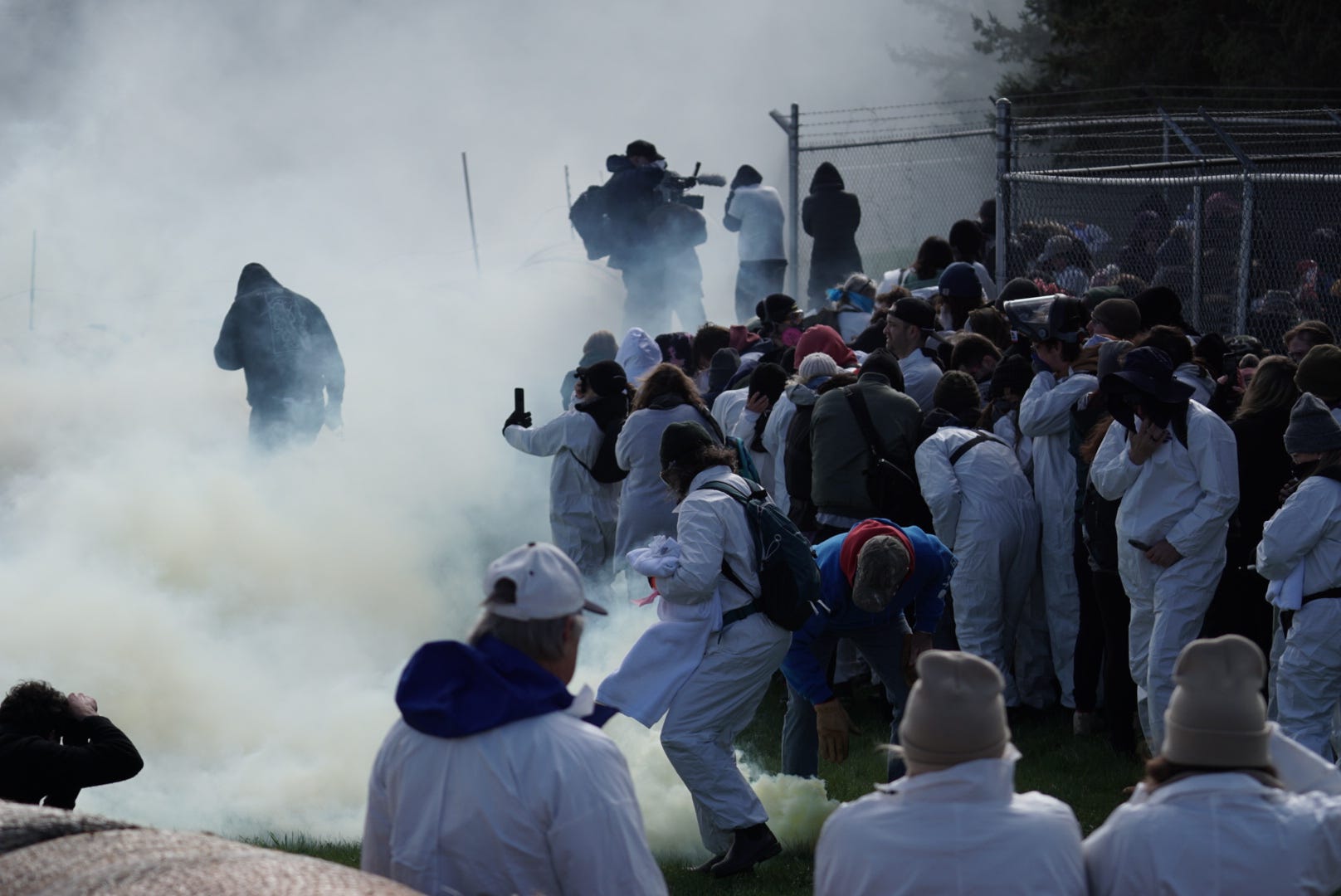 Rescuers in a cloud of tear gas outside the Ridglan dog factory farm in Blue Mounds, Wisconsin.
1. Finite pain
I’ve never been tear gassed before. Or pepper sprayed. Or shot at with other “less lethal” munitions. Here’s a few things I learned.
About five minutes before the tear gas and pepper spray, I was shot in the thigh with a bean bag from about 20 feet away. Bean bags sound innocent but there’s a reason even police call them “less lethal”. Anything below the neck is unlikely to kill a physically healthy person, though it can easily break ribs, hands, and other vulnerable bones– and indeed, many such bones were broken that day.
But a bean bag shot above the neck is life-altering or life-ending: collapsed tracheas, lost eyeballs, permanent brain damage. Protocols universally call for police to fire these at the ground so they bounce and strike people at a lower velocity, rather than aiming at people directly. These protocols are universally ignored.
Yet I barely felt the bean bag when it hit me. It hurts more right now, eight days later, than it did about three seconds after impact. Adrenaline is a hell of a drug. The bean bag didn’t slow me down at all.
Tear gas really sucks in the moment, but unless you inhale a lot of it or your lungs are already compromised, the acute effects resolve relatively quickly. But yeah, it’s physically disabling. It doesn’t just burn your lungs and your eyes. For me, my stomach had the strongest reaction. After just a few seconds in the middle of a thick cloud of tear gas, I was doubled over on my hands and knees dry heaving. If there had been anything in my stomach, I’d have vomited for sure. I wanted to get up, to walk further and get out of the cloud of gas, but my body just was not cooperating.
Fortunately, the wind started blowing a different direction quickly, and I was free of the cloud. I think within about a minute of that I’d have been back on my feet, but it’s hard to say for sure because I got a facefull of pepper spray at the same exact time. I had my back to the police, and one of them reached around the side of my head to pump it directly into my eyes. I had my normal prescription glasses on, which unfortunately just reflected more of the spray back at me.
Pepper spray, for me, was the most disabling by far. It just lasted much longer. It wasn’t so much the pain. The pain was intense, but if I’m being honest, one of my first thoughts was that it was finite.
I had found myself a few weeks prior in a conversation with a utilitarian economist. We were talking about how much pain trades off against how much pleasure to make someone’s life on net worth living. I was arguing that we tend to undervalue the badness of suffering. In response, he described having recently fallen while riding his bicycle and breaking his collar bone, and how, as he lay on the sidewalk frozen in pain, the main thought going through his head was, “Yes, this hurts, but the pain is finite, and I would willingly pay this much pain in exchange for even one really good afternoon.”
That conversation came to mind for me as I was hunched over in the muddy field outside Ridglan, dry heaving and blinded by pepper spray. And I thought, you know, I guess he was right. The point is, my mind was still surprisingly lucid.
It helped to know that these are weapons optimized for pain and temporary incapacitation rather than permanent damage. I’m sure I’d have felt differently if the same level of pain was connected to a bleeding bullet wound or something else I knew would take months to heal, if ever.
As it was, the pain was not all consuming, but it was physically disabling. If I brought all the willpower I had to bear on the problem of opening my eyes, I could keep them open for about half a second. I could still think, and talk. I had a radio earpiece in my ear, and between wretches I was trying to reassure the person on the other end of it that I was OK. That was all I could do for about 45 minutes, even as people handed me bottle after bottle of water to rinse out my eyes.
The worst pain was actually in the shower that night. One of my friends who’d been arrested in the first moments of the rescue and spent six hours lying on the dirt inside Ridglan with his hands zip tied tightly behind his back told me about some advice one of the police officers had given him. Apparently, cops take pepper spray in training once a year so they remember what they are dishing out to other people. And the one piece of advice this officer gave was to shower with your underwear on, because all the pepper spray will wash down from your face and hair across every other part of your body between it and the ground, and there are some sensitive places on the way there you’d really rather it didn’t accumulate.
My friend told me this story before I showered the night after the rescue. Yet for some reason I ignored it. I was just so eager by that point to strip my teargas-infused clothes off and get clean. This was a very stupid mistake.
The shower reactivated everything. Some of the pepper spray on my skin aerosolized, effectively filling the bathroom with tear gas again. This time, without adrenaline to protect me, the gas sent my body into convulsions. Not a literal seizure or anything, but the most intense shivering of my life. I felt so weak, tired, and cold. Sending cold water out of the spigot made me feel like I was going to faint from hypothermia. But hot water felt like dragging razor blades over the surface of my skin.
And yeah, the crotch was the worst. I never really noticed before how it’s the simplest pathway water can take flowing from the hair and face downwards to the ground. For half an hour, it was like the burning pee sensation of a UTI dialed up to 11, and also there wasn’t actually any pee to just push out, so no promise of relief. It didn’t let up after 30 minutes, so I gave up and climbed into bed shaking and burning to try again the next day.
2. Failed rescue
So you’ve probably heard by now what happened at what was supposed to be the second mass open rescue at the Ridglan beagle factory farm on April 18th.
We got our asses kicked.
Subscribe for free if you’d like to read more stories about me getting my ass kicked, physically or otherwise.
This was not the plan. The plan was to strip away the concentration camp-style fence, use fire rescue tools to pry open the doors to the barns, and carry as many dogs as we could away from what a Wisconsin judge has already ruled criminally abusive conditions to safe, loving homes.
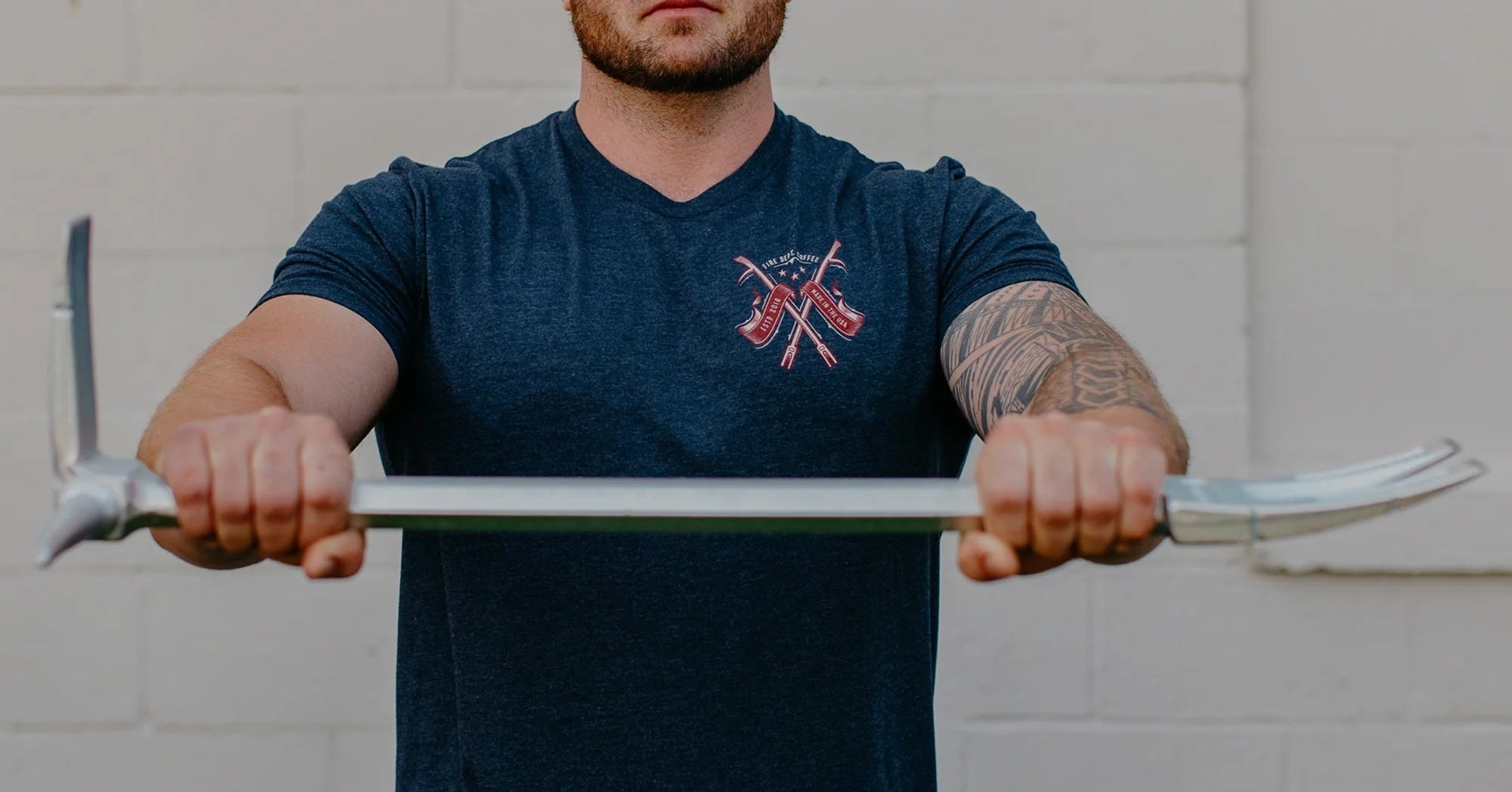 A halligan-type forced entry bar designed for fire fighters. The Dane County Sheriff has waved one of these around in an attempt to show how dangerous animal rescue people are.
That might seem like a rather audacious plan, especially given that we publicly announced exactly when and how we were going to do it. Reader, the audacity was the point. A less insane plan would not have gotten the attention of more than 2,500 people who signed up to be part of it, more than 1,000 of whom actually followed through.
And that was the core of the strategy. At the first rescue, around 100 people showed up a day earlier than announced, catching Ridglan’s security and police off guard. After 15 minutes helplessly pounding away at heavily reinforced steel doors with inadequate tools, someone noticed a window vent that seemed fragile enough. Open rescue prophet Wayne Hsiung knocked it out of the way with a famous swing, and just about everyone who planned to walked out of Ridglan with a beagle in their arms just as police started arriving.
22 dogs made it to safety. Tens of millions of people watched it on TV and social media. 35,000 of them signed up to join the campaign.
Of those, 1,000 showed up again a month later expecting more or less the same rules, namely: it takes one police officer to (wrongfully)1 arrest one rescuer. If you have more rescuers than police, then it’s a question of how many narrow chokepoints police must physically block off to stop us from rescuing the dogs, because the one line we won’t cross is physical aggression against officers or anyone else.
Well, surprise surprise, the police looked at this situation, saw 2,000 people signed up, and decided that this set of rules did not favor them. So they opted for a different set of rules. They met nonviolent animal rescuers with a barrage of chemical weapons banned from use against hostile armies under the Geneva Convention.
3. The meat grinder
I’d love to say this should have been obvious in hindsight, but the reality is there were many people to whom it was obvious with foresight. Rescuers kept reaching out to Wayne and other team leads in the days leading up to the action asking why we weren’t preparing everyone for police brutality, chemical and otherwise. When the jackboot came down hard, some of these pleas understandably gave way to outrage.
Then, smelling blood, a swarm of cancel culture gremlins who never set foot within 500 miles of Ridglan poked their ugly little heads out from the dark internet hovels they hide away in, waiting for people who have the courage to actually do stuff for animals to stick their necks out and feeding on their mistakes and imperfections.
 Cancel culture gremlins. OK, I guess they’re actually kinda cute, if you squint hard enough.
Now, reader, it’s real tempting at this point for me to throw Wayne to the gremlins, in the hopes that a pound of his flesh would suffice for their next meal and they’d slither away without devouring me too. All it would take is for me to say:
I put everything I had into this rescue. Into this crazy man’s vision. Wayne was in charge, and he confidently stated time and time again that the police were not going to resort to this kind of violence. I repeated that promise to others, staking my reputation on it. And his siren song led my body and my reputation alike right into the meat grinder of police brutality. He betrayed all of us!
I don’t have much dignity left at this point, but damn it, what I do have is just too much for me to infantilize myself that way.
I’m an adult. I made my own choices. Now, I am going to explain those choices to you, why I don’t regret or apologize for them, and why you shouldn’t either.
3.1 First, the stupid part
Let’s get it out of the way: one reason I didn’t expect or prepare for tear gas is I really didn’t want to. Magical thinking. Unicorns, leprechauns, etc.
This was, of course, not a fully conscious process at the time.2 Yet with the benefit of hindsight, I’m not sure I would do much differently.
Here’s what hindsight taught me: in worlds where the police were 1) already waiting for us when we arrived3 and 2) willing to use chemical weapons to stop us, there was no way we were ever rescuing dogs. Again, I don’t want to pretend I understood this beforehand. I didn’t even fully realize it until we’d already gone back home the day of the rescue. Until I experienced it firsthand, I just did not have a correct model in my brain for how effectively tear gas and pepper spray can incapacitate a nonviolent crowd.
One officer with one can of pepper spray can send dozens of people to the sidelines for a whole hour in a couple of minutes. A single can of tear gas might as well be a brick wall wide enough to cover a hole in the fence that would otherwise take ten officers to effectively blockade.
The rubber bullets and bean bags are the next backstop for anyone tough enough to push their way through the chemicals. The closer you get to your goal, the harder they hit you. But they are not the last line of defense.
Say we had shown up with gas masks to walk through the tear gas, and goggles to shield us from pepper spray, and ballistic helmets to protect us from brain injuries. It’s clear now that the police would have just shot us dead with live ammunition. Hunkered down behind Ridglan’s fence, they were in a fortress mindset.
Conventional military strategy says that to take a fortified position, attackers must outnumber defenders four to one. But what about when the attackers are grandmothers carrying flowers and fire rescue tools, and the defenders are shooting to kill?
This, friends, is not the logic of nonviolent resistance.
3.2 What we signed up for
That leads me to the second (subconscious) reason I didn’t prepare for police brutality: I wasn’t willing to turn us into the thing that was prepared for it. And I stand by that decision. That would have been the wrong kind of thing to win this campaign.
Imagine if we had shown up to Ridglan wearing gas masks, goggles, and helmets, carrying shields made of cardboard and duct tape to blunt the blow of rubber bullets. We would have looked like an invading army. When police started gunning us down, nobody would have questioned it: obviously, these people came ready for war. Obviously, they were expecting tear gas. They got what they were asking for.
Maybe there are a few worlds where we rock up in improvised riot gear, get a few dogs, and only a few rescuers get shot. What follows in those worlds is a federal crackdown on the entire animal rights movement beyond anything we have ever dreamt of. Our once-in-a-generation opportunity turns into an entire generation of activists locked away serving long prison sentences. The press backlash sets public opinion back even further, and Ridglan farms beagles for another hundred years, cackling diabolically the entire time.
Here’s what happened instead. Press the play button and take two minutes to watch the entire thing. As you do, try to step outside your advocate perspective and into the shoes of journalists and citizens encountering all of this for the first time.
That is the most positive local news story I have seen in ten years of animal advocacy. They are covering a group of 1000 people who tried to gain access to a dog farm with 9 inch buzzsaws. I’m sure there are things you wish they had said slightly differently, but better news coverage of direct action for animals simply does not happen.
So yes, I listened to Wayne when he said there wouldn’t be tear gas. I trusted him. I’ve known the guy for ten years. I should know as well as anyone about his tendency towards overconfidence and even dismissiveness of inconvenient ideas. This action reminded me of all those things.
But it also reminded me why I keep coming back for more punishment. The man exhibits a force of will that somehow keeps bringing him closer to the goal even when all the facts are against him.
Not long after I first met Wayne, I learned that many old hats in the grassroots animal movement thought he was a federal agent, put in place to lead starry-eyed young activists down the primrose path to long prison sentences for openly breaking into farms and rescuing abused animals. Ten years on and he has earned the grudging respect of all of them. After dozens of rescues, Wayne is one of only two people to serve any jail time, neither for more than a month. He’s won half the cases outright, including some of those with the longest odds– like convincing a rural Utah jury to nullify his charges for rescuing baby piglets from one of the largest and most politically powerful factory farm corporations in the country.
One month ago, he invited you to join him on this brazen crusade. And you did it.
It wasn’t a mistake.
4. History called, and you answered
We had a plan, dear reader. It did not involve getting our asses kicked on a muddy field in Wisconsin. It involved rescuing dogs. I burned through every ounce of energy in my cells in the four weeks leading up to April 18 because I wanted to rescue dogs. If I had known we were just going to get our asses kicked on a muddy field, I could have worked about half as hard, and slept a lot more. It wouldn’t have taken any special prep. Just show up, get ass kicked, go home.
But that’s not how it works. We had to be the kind of people that would rescue dogs unless they kicked the ever-living shit out of us, otherwise they wouldn’t do that. We needed to come up with a plan to get past barbed wire fences, reinforced doors, and their bizarre medieval moat full of dog shit surrounded by hay bales.
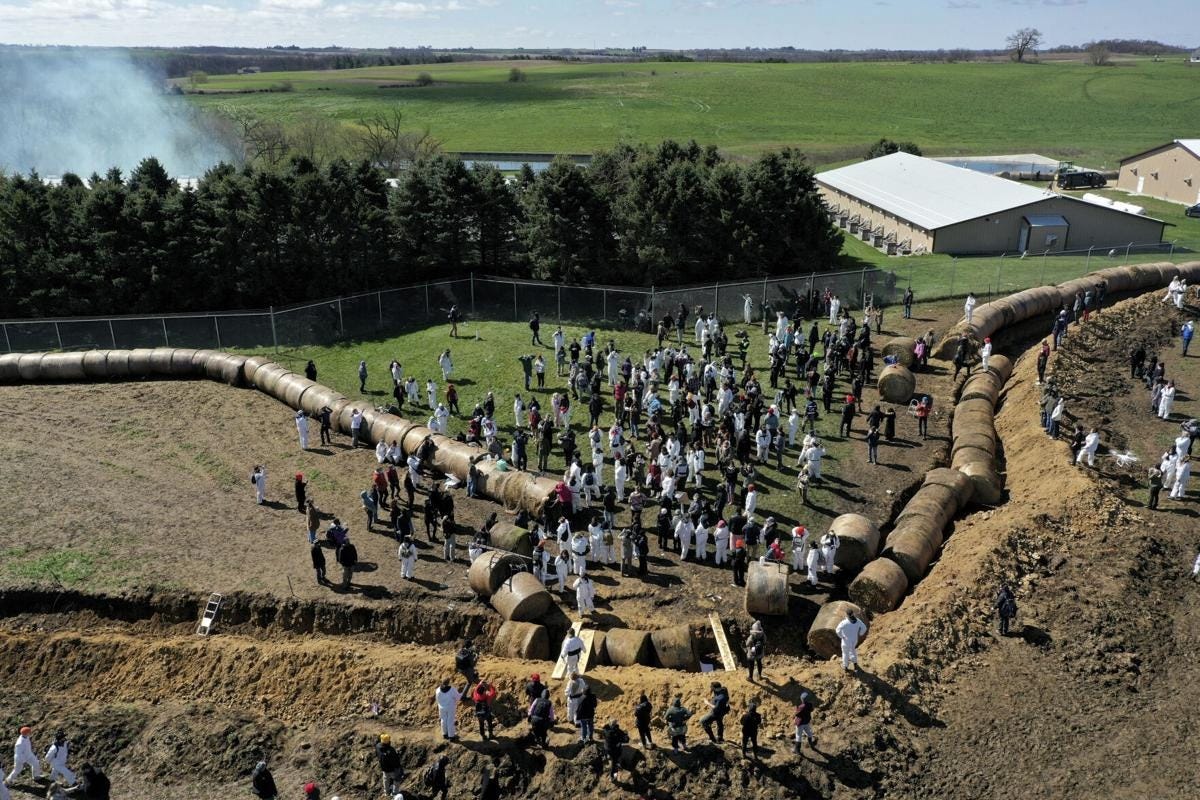 Seriously, what backwater Wisconsin ass shit is this that you reinforced your dog factory farm with hay bales?? And a trench full of dog manure??
If the fence could have stopped us, they wouldn’t have needed tear gas. If the tear gas hadn’t stopped us, they would have needed bullets. I’m glad the tear gas stopped us. That is the ideal amount of force I would consider a success.
The media and political class, at least, seem to agree. In the week since this ass kicking:
The action has become a national media sensation, leading to four times as much internet search interest as the March 15 rescue according to Google trends.
Lara Trump, Laura Loomer, Tomi Lahren, Nancy Mace, and other conservative luminaries have issued blunt statements against Ridglan framing animal rescue as a core part of their political platform.
Ridglan’s own congressman, Democrat Mark Pocan, put out a statement calling for the immediate release of the dogs and closure of the farm, and was joined by the leading Wisconsin Democratic gubernatorial candidate and half a dozen state lawmakers.
The Accountability Board announced a 6-figure TV ad campaign roasting Governor Tony Evers for wrongly claiming he doesn’t have the authority to enforce animal cruelty laws against Ridglan.
Prominent civil rights attorneys with no connection to open rescue have sued Ridglan for criminal abuse of dogs and rescuers alike.
Many people have asked: if there was a chance police would be able to stop us with tear gas and rubber bullets, why wasn’t there a Plan B? Wayne has apologized profusely for what happened, and for not having a Plan B. I know the guy, and I tell you these apologies are sincere.
But I don’t understand why.
Reader, there was a Plan B. It’s what happened. Plan B was you and me both getting the shit kicked out of us on a muddy field in Wisconsin. It’s not like we consciously thought of it as Plan B. We never talked about it, and we didn’t need to prepare for it. It was perfect. Any preparation would have made it worse.
What’s more, you knew that was Plan B! Or at least, Wayne told you it was. He spent the four weeks leading up to April 18 publishing blog posts about Gandhi’s salt march in India and MLK’s children’s march in Birmingham.
These are stories about regular, humble people getting the shit kicked out of them. The shit kicking in the stories is not some side quest; it’s the main event.
Rescuers wanted training for pepper spray. Fair enough. Having now been pepper sprayed, I will say there’s not much you could do to prepare for getting pepper sprayed other than getting pepper sprayed. Ten years of daily meditation probably helped, but I’m not sure what I would have done if I had a few hours to train people. It would have helped a little bit for more people to know the right way to rinse people’s faces, but this just makes it stop sucking slightly sooner. It is still going to suck almost the same amount, and there’s really no way around that.
More to the point, I think there might be some misinterpretation of Gandhi and King’s movements here. Take the 1963 Children’s March in Birmingham, widely considered one of the key turning points in the civil rights movement. Most of the famous photos you’ve seen of civil rights activists being attacked by dogs come from this episode.
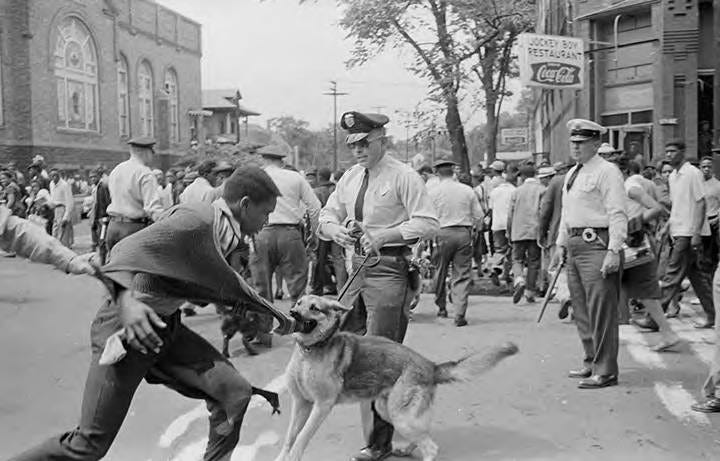 MLK send middle school kids into the meat grinder in Birmingham.
Were these deeply trained nonviolent soldiers being attacked by police dogs, having bits of flesh torn from their bodies along with bloody clothes?
No, they weren’t. They were completely normal high school kids– and that’s the point!
King actually caught a ton of flak for this from other civil rights organizers at the time. He was basically traveling across the South from city to city, desperately trying to initiate some kind of mass protest event somewhere with the explicit goal of overwhelming the capacity of the local jails so that police would have no choice but to stop arresting Black people for daring to walk into segregated businesses. What changed in Birmingham is that King finally relented to the urging of his more radical advisers, especially Bayard Rustin, and decided to finally deploy their most controversial weapon: school children.
Grown adults were too scared to face down police violence and legal repression. They had too much to lose. But kids were pliable. So 63 years ago almost to the day, King sent his organizers around to every school within ten miles of Birmingham, where they told the kids to skip class starting on May 2, come downtown, and march from the 16th St. Baptist Church into the most heavily segregated downtown area.
The kids had no training, and King knew there was almost no limit to the violence they might face. Birmingham had already earned the nickname Bombingham for deadly violence against civil rights activists. A few months later, four young Black girls were murdered in a bombing at this very church.
In the end, the police didn’t shoot into the crowd with guns, opting instead for fire hoses and attack dogs. After two days of this carnage, King had successfully filled not only the city jail, but also a nearby baseball field temporarily converted into a giant holding pen for bloodied up Black children singing civil rights songs from dawn until dusk.
Still, in the end, it wasn’t the police who caved. They would have filled up another baseball field. It was the Kennedy administration, unable to stand another day of sensational news stories rocking the country with images of middle school children being brutalized, who finally put their foot down in the protesters’ favor.
You can imagine the earfuls King got from parents while their kids bled inside Birmingham city jail. But I suspect many of them came around when the Civil Rights Act passed the next year, ending nearly a century of Jim Crow laws.
5. Thinking in bets
Let’s review: about a month ago, this dorky sentimental Chinese guy with a crackpot legal theory went onto the internet and said: _We’re going to do Selma, Birmingham, the Salt March, not for ourselves, but for helpless animals who nobody cares about. I need two thousand people. Are you in?_4
And you, reader… you stepped forward.
THAT’S FUCKING INCREDIBLE!
The kids in Birmingham weren’t soldiers. And you weren’t either. That’s exactly why what you did is so courageous.
People will ask: did we really have to keep charging up against the wall of pepper spray and rubber bullets a third, fourth, fifth time, when each time it became more and more clear that we were not getting anywhere near those dogs?
Yes. Yes! We did have to! For two reasons.
First is thinking in bets. Step back to the day before the action. I thought we had a good chance of rescuing dogs. I was planning to rescue lots of dogs, and acting accordingly.
But say you could rewind to that moment and tell me: Listen, Aidan, you have only a 10% chance of getting dogs out of Ridglan. No matter how effectively you play your hand, you have a 90% chance of losing.
Do you think I should have done anything differently? I don’t.
A 10% chance of making history is pretty good odds. I’ll take that shot any day, and I hope everyone else would too, even if it meant throwing me into a meat grinder of police brutality. Six shots like that over a few years and suddenly we are favored to win.
Now, after the 18th, it looks more like we had a 1% chance. Hindsight makes things easy.
But it also looks like we probably only had a 10% chance of success at the original rescue on March 15. I mean, now that we know the lengths the Dane County Sheriff’s Office will go to protect criminal animal abusers from nonviolent rescuers, it’s nothing short of a miracle that we walked in and rescued 22 dogs without so much as being tackled to the ground.
Sure enough, plenty of people told Wayne before the 15th that his plan was crazy, reckless, dangerous, irresponsible. I’m so glad he ignored them. And ultimately, I’m glad he ignored them the second time, too.
When the first wave of rescuers were tackled to the ground on the 18th and had all their tools confiscated, chances started looking grim real fast. Right away, I’d have put it at one in ten. Then the second wave, including me, was brought to heel by chemicals, and it clicked down to one in twenty. Each subsequent wave made our odds look longer: one in one hundred, eventually one in one thousand.
I confess: I was ready to give up at that point. But so many other people weren’t. As my eyes finally cleared, I saw I was surrounded by rescuers whose determination hadn’t missed a step. They were still shooting bottled water into their eyes as they came to me telling me everything that had happened and the new plans they were cooking up for how to get past the police. We still had one buzz saw that hadn’t been taken by police, plus about five angle grinders and at least one halligan. We had hundreds of people behind us, battered but nowhere near broken.
How could we give up on even a one in one thousand chance of rescuing just one dog from Hell?
Well, to answer that question, we need to consider the tradeoff. We had a one in one thousand chance of rescuing dogs, and a nine hundred ninety-nine in one thousand chance of… what, exactly? An unprecedented national news story? Selma for animals? How is that a failure at all?? Were you paying attention??
OK, it wasn’t quite that simple. We could have failed to get news, so it wasn’t quite 999 out of 1000. Thankfully, we didn’t fail, and the story is legendary.
Also, there was some chance, probably more than 1 in 1000, of somebody getting killed or permanently maimed by a bean bag or an actual bullet. Which is why ultimately, I called off the last attempt to push our way through the fence. There was no need to risk lives. We hadn’t rescued dogs, but we had a win, and even then I knew we could use what had happened to get all the dogs out.
6. The future is (still) watching
But even that was not the most important thing our suffering purchased that day, which brings me to reason number two that we needed to keep trying as long as we did.
We talked about the Children’s March earlier. There’s a great short documentary about it on YouTube worth watching if I piqued your curiosity. But even if you’ve seen it before, I suggest that watching it again now will feel different. It will serve as a reminder to you of the scale of the stage that you have just stepped onto.
For that afternoon of pain, perhaps for a few short years of Wayne and I wallowing away in a federal prison cell on your behalf, all of future history will know that there were a thousand people who had the courage to take all of this brutality and violence willingly into their own bodies for a vanishing sliver of a chance to save a few terrified, helpless, broken creatures who could never in a million trillion years return the favor.
Going forward, there will be no question: 2025 was the last year people could stay on the sidelines. Documentaries will be made, and you will be in them. The movement is going mainstream. We’re only going up from here.
History called. You answered. Hold your head up! You’ve already done the hard part. Now you just need to keep it together. Wayne invited you to join the company of Rosa Parks and Mahatma Gandhi. Now that you’re among them, it’s time to start acting accordingly.
I don’t want you to take my word for it, so I leave you with some select words from some of your fellow rescuers. Here was a text I got the day after the action:
I’m finally reaching out because the symptoms have subsided. I started feeling really nauseous yesterday, so we left. I figured it was the tear gas from when Jaden and I spent the first half up on the hay bales. It got so bad this morning I went into the ER because I had a fever and constant vomiting. I’m feeling better now, and we still want to stay involved. We live only about an hour and a half away and will be there any time needed.
This motherfucker got out of the ER like an hour ago and is already saying put me back in, coach! They can’t be stopped! Be like this person. Or like the two people who had this exchange in a Zoom chat a week later:
1: Is it normal to still have a cough, be wheezing and be short of breath one week after getting tear gassed?
2: I don’t know, but same here. It sucks, I have autoimmune conditions and I think I’m sick, calling doc tomorrow. It’s not gonna slow me down, only motivate me more.
1: Same here, it just makes me more motivated.
What can I even say? These people make this movement great. They are doing this on behalf of helpless animals. And the future is taking notice.
This is why we will win.
Build on,
Sandcastles
Addendum: Someone bought the dogs
First things first: this is a good thing. Cause for celebration. ~Two thousand entire beings who as of this morning were still locked in tiny cages and facing indefinite imprisonment inside similarly small cages—or worse—are now on their way to safe and loving homes, where they can begin the long process of partially healing from the extraordinary trauma of their hellish lives up to this point. If they were humans, we wouldn’t hesitate to take this win, and we shouldn’t hesitate for nonhumans.
Thank you to (in no particular order) the Beagle Freedom Project, Center for a Humane Economy, Big Dog Rescue Ranch, and Lara Trump for making this happen.
Nonetheless, it raises questions worth discussing. I’ll tackle three:
If people just wound up buying the dogs, was the campaign even necessary?
What does this mean for the next steps of our political, legal, and media strategy?
Should we in general be willing to buy out animal abusers?
A1: Does this count as a win for the rescue campaign?
Definitively yes, and here’s why: the negotiations that led to this deal started weeks before even the March 15 rescue. Soon after Ridglan announced that they would be surrendering their breeding license last year, a dog and cat rescue organization reached out and offered $150,000 for them to surrender the dogs and shutter the business.
That might sound like a lot, but it was barely 5% of the list price of the dogs, who Ridglan claims could be worth $2,000 to $4,000 each. But Ridglan’s reputation was in tatters, making it hard to sell their dogs, and they’d already agreed to shut down their business– or so it seemed.
As months dragged on and Ridglan dug their heels in, it became clear they were not planning to shut the business down after all. They were looking to squeeze through a loophole in the settlement they’d signed with a court-appointed special prosecutor to avoid felony animal cruelty charges.
This, of course, is what necessitated further escalation in the campaign, culminating in the two rescue efforts. But negotiations continued in parallel, carried on by organizations unaffiliated with the open rescue movement.
When the March 15 rescue grabbed attention across the country, new benefactors were inspired to step forward. The total amount offered to Ridglan went up to $350k, then $500k when Lara Trump got involved through a Florida-based dog rescue on whose board she sits.
The morning of April 17, I learned that the offer had gone up to $650k, and it seemed like a deal was within reach. But a few hours later, negotiations collapsed. I wondered whether a deal had never been close after all, and whether Ridglan was more interested in stalling and distracting us than negotiating in good faith.
The rest is history. We went forward with the action. By the end of the day on the 18th, Ridglan certainly felt triumphant. Every police force from 100 miles around had converged to serve as their private security force, at no cost and with no accountability. We’d gotten nowhere near rescuing dogs. When yet another donor stepped forward during the middle of the fracas raising the total offer to $1 million, Ridglan told him to get lost.
I’m not sure how long their honeymoon phase lasted before they started to realize they had fucked up. Maybe it was the next day, when their own Congressman tweeted against them. Maybe it was the day after, when a crowd of 100 rescuers spent the entire day sat in at the state capitol while positive press coverage poured in. Maybe it wasn’t until Friday, when a six-figure TV ad campaign from The Accountability Board started blasting the Governor for sleeping on animal cruelty enforcement.
Whenever it was, they eventually came crawling back. Not to Wayne—they hated him too much—but to the separate coalition. I’m as surprised as they were that the offer was still on the table.
This win happened because of the campaign. Only the rescues brought enough national attention to Ridglan for these donors to step up in the first place. Only the campaign made it clear to Ridglan that they couldn’t continue to get away with their massively profitable criminal business enterprise forever– and by the way, the campaign is the only reason they were investigated and had to surrender their breeding license in the first place.
And the campaign is the only reason this story will now be a central part of U.S. animal rights history for decades or centuries to come, instead of an unnoticed story of one more business shutting down while nothing fundamentally changes. It’s up to us to ensure the campaign now delivers even bigger wins.
A2: What comes next for the campaign?
I admit there is a part of me that finds this outcome anticlimactic. I’m glad the dogs are getting out starting today, rather than waiting longer. But I can’t shake the feeling that we could have won without paying them a penny, and that they don’t deserve a penny and in fact deserve lengthy prison sentences.
A judge and a public prosecutor, both from Wisconsin, separately found that conditions at Ridglan farms constituted felony animal abuse. And then, they… let it keep happening for 8 more months, and maybe indefinitely.
This is outrageous. Animal advocates often find ourselves on the wrong side of a system of laws that almost always treats animals as property rather than as beings with their own interests. We throw our bodies into the gears of this system to try to force change, facing arrests, prosecution, and jail time for simply rescuing animals from violence. Yet the worst punishment is when defenders of the status quo patronizingly lecture us that however they personally feel about animals, we’ve all got to respect the law.
Then Ridglan comes along, and manages to violate the vanishingly few laws that exist to protect animals abused in farms and research labs. In just a few randomly chosen months of routine operations, a prosecutor finds evidence for three hundred and eleven felony animal cruelty charges. And the settlement is that they are allowed to keep committing felony animal cruelty for 8 more months, and maybe forever apparently.
I hate being cynical like this. But I don’t see how this is anything other than a straightforward case of the rich/powerful/anyone with a corporate EIN being given a separate justice system from the one ordinary people like you and I are subjected to. I have friends who spent years in federal prison for doing nothing but freeing animals from factory farms. Ridglan commits felony abuse and gets a million dollars.
I was feeling great about our strategic position against Ridglan. TAB’s TV campaign against Governor Evers is running for two more weeks, and we were on track to put an unprecedented (for animal issues) amount of grassroots pressure on him to act. He’s already getting roasted in the media for claiming he doesn’t have the authority to enforce animal cruelty laws against Ridglan, as if he’s not the one guy whose job that is along with his Attorney General Josh Kaul. Wayne’s prosecution will be the animal rights show trial of the century, creating endless opportunities for the campaign along with our own plaintiff’s suit against Ridglan and the Sheriff.
Well, all that’s no longer needed. I honestly haven’t had time to think about what we should do next with our current momentum. Try to pass a ban on dog farming in the Wisconsin legislature? Or target federal action on animal testing? There are other options, and the devil is in the details. But we can’t let all this energy evaporate.
A3: Is it ever wise to buy out animal abusers?
As a younger activist, I would have said the answer is always no. People should not be rewarded for abusing animals. Their businesses should be shut down, period.
I still wouldn’t support buying animals out of violent businesses, because you’re just paying for the next animal to be bred to replace them. But buying out entire businesses is different.
Like it or not—and I certainly don’t—animal abusing companies (other than Ridglan) have been playing by the rules of the game that were presented to them. In any given case, they’ve invested years of work and large amounts of capital, often financed by debt, into building up businesses profitable enough to provide for their families, employees, and investors.
That doesn’t mean businesses need to raise animals in the cheapest ways possible, no matter how cruel. It doesn’t mean we should hold anything back when pressuring them to adopt higher standards or move away from animal exploitation altogether. And it doesn’t change the fact that society as a whole needs to move away from torturing animals for profit as fast as possible.
Increasingly, however, I do think it means that society, and perhaps animal advocates specifically, should be willing to offer some kind of restitution if we want farms and slaughterhouses to close down sooner than the market would have them otherwise.
Problem is, the entire budget of the global animal rights movement is less than the revenue of a single large slaughterhouse. We’re nowhere close to being able to buy out significant elements of the industry. We’re not close to shutting them down by other means, either.
So eventually it’s just a question of cost effectiveness. In this case, the majority of the money was coming from outside the animal movement, meaning it would not have otherwise been spent on transformative animal advocacy work. Given that, I see no way this wasn’t the best thing this money could have been spent on. Not only did it save dogs, but it delivered a huge win that we can keep building on. So, setting aside Ridglan’s decorated criminal history, I support it.
Thanks for reading Sandcastles! If you found this essay useful, the best way to help is to share it with another activist.
1
There are many layers to this strategy. One is that because the conditions at Ridglan have already been found to constitute felony-level animal abuse, the law actually supports us intervening to stop ongoing felonies at Ridglan where the local law enforcement have utterly failed. You can read about that elsewhere.
2
What follows from here is a precarious form of reasoning, which smells dangerously similar to post-hoc rationalization, i.e. me coming up with elaborate explanations after the fact for why my prior decisions were actually the right decisions. I acknowledge this and you should be warned, but I still believe every word of it.
3
See Wayne’s post for an explanation of how the plan was to arrive at Ridglan a day earlier still than when we actually showed up, but that plan was foiled by torrential rain and tornado warnings at the exact time planned for the action. We’ll never know what would have happened if we’d gone that day.
4
OK, maybe you were persuaded instead by the washed-up blogger with even less to show for himself. If you are taking my advice on anything, you’ve got much bigger problems.
Build on, Sandcastles