It’s Everybody’s Fault
Imploring animal advocates to stop confusing moral and strategic questions
My friend Jack (aka Humane Hancock) just released his new animal rights documentary on YouTube. It has everything I want to see in a pro-animal movie: rather than bombarding the viewer with facts, The Dying Trade takes us on a personal journey centered on Jack’s strained relationship with his father, a slaughterhouse worker whose family has been in the meat industry for generations. The film is guaranteed to leave every omnivore with a vegan friend or family member squirming in the best way possible, and it does it all without a single frame of gore.
There was even an appearance from my personal fashion icon, Temple Grandin. (More on her in a moment.)
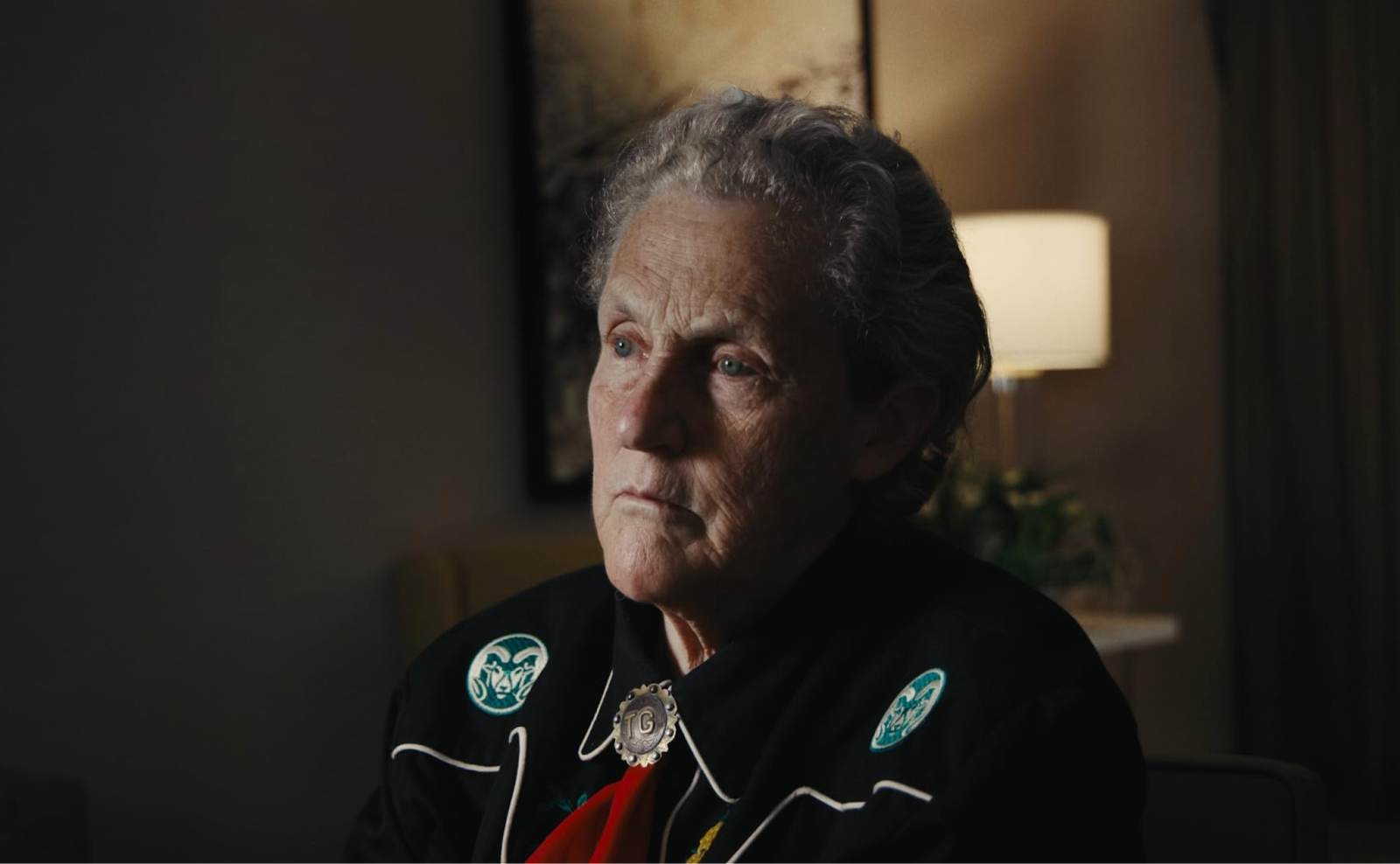 Bolo tie stamped with your own initials: $120. The rizz to actually wear it: priceless.
I recommend watching it with people in your life at the earliest opportunity. But there was one side quest in particular that got me thinking. Without ever speaking to each other directly, two of Jack’s interviewees act out a dialogue that must have played out hundreds of thousands of times between animal activists:
Who is to blame for factory farming? Companies, or consumers?
Subscribe today to get the hottest Temple-inspired outfits straight to your inbox.
On the consumer side, we hear from Alex Herschaft. Alex is a legend in the animal movement, with an advocacy career dating back to the 1970s. But he’s most notorious as a Jewish holocaust survivor willing to call out what he sees as the analogy between slaughterhouses and Nazi death camps. He quotes fellow survivor Isaac Singer: “In relation to animals, all people are Nazis; for them it is an eternal Treblinka.”
Alex’s point is simple enough: if consumers weren’t eager to pay for meat, corporations wouldn’t confine animals in factory farms. The buck stops with the buyer.1 Alex goes so far as to exonerate the producers, saying “I don’t blame the meat industry at all.” They’re just responding to demand.
The opposite position was voiced by Gail Eisnitz, an undercover investigator with an equally long and storied career. In Gail’s view, it’s pointless to blame consumers, who understandably feel that they individually have no power over the faceless multinational corporations ushering animals from factory farms to slaughterhouses to grocery store shelves.
“These corporations,” Gail says, “are wholly to blame. The meat industry is the source of the problem.” And we focus on holding them accountable. After all, when investigators like her expose the lies they peddle to market their products, the public is outraged. This deception is a choice by animal abusers; it can’t simply be chalked up to meeting public demand. The dishonesty of these factory farm companies creates the demand.
But Alex doesn’t buy it. Consumers know that if they looked into where their meat comes from, they wouldn’t like what they find.2 Part of the product these companies are selling is the comfortable lie people need to believe in order to keep eating animals. Consumers are seeking out that lie, and willfully avoiding the truth.
1. The wrong question: who is responsible?
Over the years, I’ve participated in this same debate more than once. I’ve been on both sides at different times. Like so many arguments in animal advocacy, it does double duty as both a moral and a strategic question. People arguing that consumers are morally responsible usually conclude that we should focus our efforts on public outreach, whether AV-style vegan outreach or DxE-style public disruption. Meanwhile, those who see the responsibility falling on boards and CEOs naturally gravitate towards corporate accountability campaigns.3
So who’s right? Who is responsible, at the end of the day? Consumers, or CEOs? Or, for that matter, is it the lawmakers and regulators setting abysmally low standards that allow this all to happen? And what about the actual workers who do the deed, shoving animals into cages and slicing open their still-bleeding necks? There are far fewer slaughterhouse workers than meat eaters; if consumers could theoretically walk away from the industry, then workers each have much more individual agency.
I think this is easy enough to resolve. Let’s take Alex Herschaft’s invitation and imagine the factory farm industry exactly as it currently exists, but replace the animals with humans– if you like, humans of a marginalized ethnic group or disenfranchised class.
Take a second to really imagine it: every day, millions of people wasting away in tiny wire cages, until they are dragged to the slaughterhouse, hung upside down, slaughtered, butchered, packaged, sold, spiced, barbequed, and devoured by happy and unhappy families across the country.
Pop quiz: who is responsible for this imaginary atrocity?
CEOs
Consumers
Farm and slaughterhouse workers
Complacent lawmakers and regulators
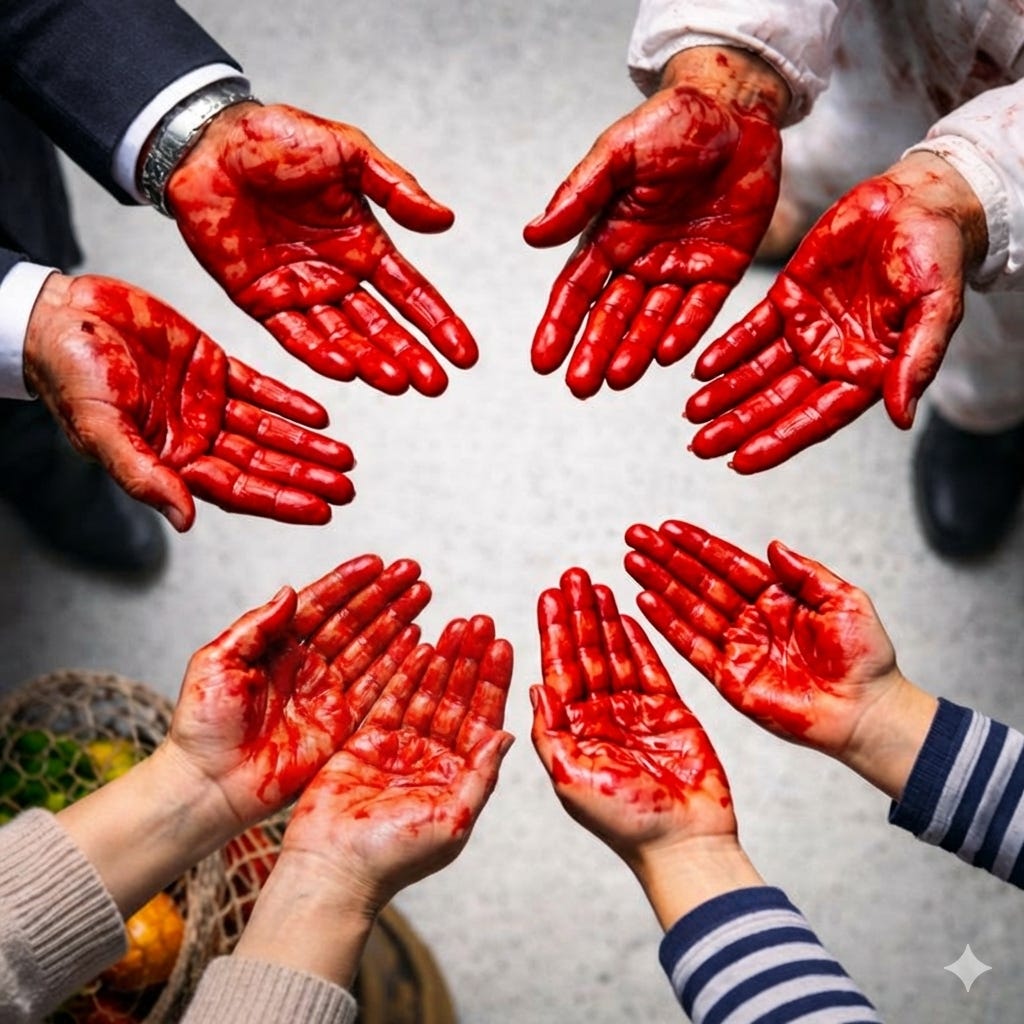
The answer is obviously: everyone! Each of these groups could bring the entire industry crashing down if they withdrew their unique participation. But they don’t, and the blood keeps flowing. Oceans of blood, every single day.
One of the most notorious names associated with the Nazi holocaust, arguably second only to Hitler himself, is Adolf Eichmann. Eichmann was not a leader of the Nazi party, or even among the top 1,000 most influential members. He was not a soldier or executioner who carried out killings. He was simply a bureaucrat, a pencil pusher in the administrative apparatus responsible for the logistics of mass death. For his role, Eichmann was not only tried and hanged– he became a meme, his name synonymous with the banality of evil. I’ve never heard anyone argue Eichmann was treated unfairly.
By this standard, not just the back office accountants and HR heads but even the law firms, insurance companies, advertising agencies, and other contractors that partner with slaughterhouse companies have blood on their hands, more than they could ever hope to rinse off.
I used to argue that consumers and workers couldn’t be held responsible because they didn’t have enough agency. That is, they lacked a meaningful choice: workers, because they are drawn from among the lowest-optionality laborers in our society, and consumers, because their individual participation is too infinitesimal to matter. But these break down under the human farming thought experiment. A worker or consumer who tried to use these defenses would be hanged just as surely as Eichmann, with as few tears shed over them.
In my experience, vegan activists often enjoy debating the question of free will: do people really make their own decisions in the world, in a manner for which they can be held responsible? Or is the sense of choosing an illusion, a condition arising from the same chain of events that predetermines all of your actions? Can the CEO of a factory farm company who oversees and profits from the torture and annihilation of hundreds of millions of creatures every year be said to be making a choice, any more than the desperate worker or ignorant consumer?
I think this is the wrong question. I propose a better one:
Who fucking cares?
2. The right question: how do we stop it?
Free will is a question of philosophy, not a question of fact. Either everyone, from CEOs to accountants to consumers to politicians, are mass murderers, or they/we are all helpless pawns acting out a predetermined drama. This question has no bearing on our ability to stop factory farming.
The animal movement has an unfortunate tendency to confuse moral and strategic debates. The classic welfarist vs. abolitionist debate is a prime example. Certainly some people have criticized incremental welfare reforms from a strategic standpoint. In years past, I thought my own hostility to cage-free and other welfare campaigns was strategic. But in hindsight, the line was often blurred. I didn’t want to live in a world where gradual reforms worked better than a clearly communicated vision of transformational change.
But it is not only radicals who make this mistake! Indeed, criticisms of radical tactics often similarly dress up moral discomfort in strategic nitpicking.
I had been an animal activist for eight years the first time I joined a protest with Animal Activism Collective (AAC) and the Coalition to Abolish the Fur Trade (CAFT). I’d gotten my start in the movement with Direct Action Everywhere. DxE thought of ourselves as staunchly on the radical side of the spectrum, to the point of disparaging cage-free campaigners like The Humane League (who themselves looked radical from the standpoint of even more moderate groups like the Humane Society of the United States.)
I’d participated in hundreds of protests inside restaurants and grocery stores, and I thought I’d seen it all. I was shocked on multiple levels when my first AAC/CAFT protest was by far the rowdiest activism I’d ever participated in. Picture 40 activists charging into a restaurant barely larger than a typical living room, blaring 13 megaphones and a professional-grade referee whistle. Cups of salsa were flipped, individual customers were screamed at, and before the night was over, more than one argument turned physical.
DxE was radical, but we were strongly organized around “Nonviolence in act, speech, and tone.” This was both a moral and a strategic commitment (which, by this point, should raise a yellow flag.) DxE’s theory of change was all about winning over the public. Yes, we would disrupt their fancy night out feasting on animal corpses, but we would do it with a tone of stern compassion, pleading with them to consider the animal’s perspective. We were hoping to strike a balance, forcing people to pay attention without turning them against our message.
Despite the superficially similar tactic of disrupting inside businesses, AAC and CAFT’s theory of change is completely different. Their goal is not to win over the public, but to inflict maximum pain on the target business until they cry uncle– surrendering to a campaign demand to drop foie gras from restaurants or fur from luxury fashion brands.
I understood this, but I was still surprised at first by how much these protests target individual customers: getting up in their faces, screaming epithets at them, and even dumping cups of salsa on their laps. And I was uncomfortable with it. After all, if the target is the business, wouldn’t it be better to have customers on our side, so they go and tell the company to listen to us? On a deeper level, it just didn’t feel right or good to scream and curse at random people staying at a Marriott hotel because the company had reneged on a cage-free egg commitment the guest had never even heard of.
It all clicked for me during a foie gras protest at a restaurant in Denver. When we had first charged into the restaurant megaphones blazing, the expressions on most customers’ faces was smug condescension, laughing and sneering at the ridiculous vegan protesters. It was an effective defense mechanism, to be honest– their smiles made me wonder if we hadn’t made a mistake. Maybe we were just the night’s entertainment, and weren’t harming the company at all.
It was somewhere around the third time an infuriated patron splashed their full glass of water onto my chest (that is, maybe the 15 minute mark) that I noticed the smiles had disappeared– or rather, they’d migrated from customers to protestors. The initial amusement had passed. Diners were pissed.
Reader, we screamed our voices hoarse inside that restaurant for another 45 minutes. Cops never showed up. Several tables ate their entire meal, had their $100-a-plate bills comped by apologetic waitstaff, and left the restaurant all in the cacophonous din of our joyous rage. When I finally stepped out into the warm summer night with my soaking wet t-shirt, I had no doubt about how much agony we had caused customers and business alike.
A few weeks later, the company caved and announced they were permanently removing foie gras from their menus at a dozen locations.
Were these customers responsible for the restaurant’s use of foie gras? Many of them probably don’t even know what foie gras is , or that it is produced by force-feeding ducks. Most of them probably didn’t order it.
Who gives a shit? They were all chomping down on other factory farmed animals. They might not know about force-feeding, but they know about the cruelty of factory farming and slaughterhouses in general– and to the extent they don’t know, it’s because they’ve actively avoided finding out.
Even if I’m overestimating their complicity, it just doesn’t really matter. Who cares if they had a bad night out? They’ll be fine, and they even got an interesting story to tell at their next party. All that should matter is whether it works to get animals out of factory farms. In this case, it pretty clearly did.
This doesn’t mean maximally aggressive tactics are always appropriate. I recently argued animal activists should accept that most people won’t go vegan, and offer more incremental ways ordinary people can align their actions and identity with animal advocacy, such as donations to “offset” the harm of their diet.
My reason for supporting strategies like offsets is not that I believe anyone deserves to be handled with kid gloves. Watching people fuel their self-absorbed lives by chowing down on tortured animal carcasses makes my blood boil. I want to scream at these people. I wish that taking a strong moral stance around veganism as the moral baseline was working. But it just is not. It’s failing spectacularly, with rates of veganism stagnating as the number of animals in factory farms skyrockets.
One commenter on that post wondered about what Gary Francione would think about the veganism/offsetting debate. Francione was a legal scholar and moral philosopher whose writings on abolitionist vegan ethics inspired countless animal activists. His book Eat Like You Care is still my go-to recommendation for intellectually-inclined friends considering veganism.
But there is simply no reason Francione should have the last word on strategic debates in the movement. Moral philosophy and social movement strategy are entirely unrelated disciplines, as Gary demonstrated through a fanatical fixation on individual vegan advocacy to the exclusion of all other strategies. Francione was one of the most bitter critics of cage-free and other incremental welfare campaigns, and his writing on the subject perfectly illustrates the moral/strategic confusion endemic to the animal movement. Yes, Francione would hate the offsetting strategy, as he hated vegetarianism, reducetarianism, and even fur and foie gras campaigns, which he dismissed as “single issue” betrayals of animals while never engaging with the strategic arguments of their proponents.
You wouldn’t ask a climate scientist how to build a social movement or get laws passed protecting the environment. Don’t think like a moral philosopher when designing strategy for the animal rights movement!
3. “You said we’d come back to Temple Grandin”
I sure did. In case you are unfamiliar, Temple is the most famous/infamous animal welfare scientist alive today. Claiming that her autism helps her relate to animals on an intuitive level, Temple revolutionized the design of slaughterhouse facilities in ways that are widely agreed to make cows, pigs, and sheep less anxious in their last moments before being killed. She has spent her career reforming the meat industry from the inside– and she’s still a customer. When Francione sets up a straw man to argue against abolitionist vegans who believe in the strategic value of incremental welfare campaigns, Temple is the real-life person he could be criticizing.
Yet even Francione might feel a soft spot for the flesh-and-blood woman we meet in Jack’s film, arriving at the end of her career with a heavy conscience. Her face shows anguish as she describes the standard practices of her industry, and when she asserts that conditions have improved over the course of her career, the defensive tone in her voice seems directed more at herself than at Jack. She bluntly refuses to discuss chicken farming altogether.
Is Temple morally culpable for this violence? I’ve described her before as a godsend to the industry, the perfect messenger for the humane lie. Yet PETA founder Ingrid Newkirk, hardly a welfarist pushover, said in 2003 that “Temple Grandin has done more to reduce suffering in the world than any other person who has ever lived.” That’s, like, pretty high praise. If someone ever said that about me, I’d die happy, which is a bummer because definitively nobody ever will.
And yet: would I stand outside Temple’s house at 3 am every night for a year if that’s what it would take to win a campaign? Would I dump a bucket of fake blood on her every day, harass her boss until she gets fired, slash her tires, crash her kids’ weddings and grandkids’ birthday parties, if that would make a dent in the atrocity being carried out against animals every day? I absolutely would.
And if instead, I thought that what it would take to win is to become Temple’s best friend, to lift her up as the face of our movement, to redesign my whole wardrobe after hers,4 to sit beside her at those same weddings and birthdays as she chows down on a “humanely slaughtered” steak, I’d do all of those things, too.
I’d even disrupt you, reader. Not because you once ate animals, or because you still could work harder, or smarter, to help put a stop to all of this, and every day you don’t you’re letting animals die.
I wouldn’t disrupt you because you’re to blame– I don’t know if you are, and I don’t care. I’d do it if that’s what it took to win.
Build on,
Sandcastles
p.s. If you don’t call your senator to tell them to oppose the Save Our Bacon Act, it really will be your fault when every farmed animal protection law across the country is nullified overnight, and I will show up to protest outside your house. Do it here.
If you found this essay useful, the best way to help is to share it with another activist.
1
or… comes from them?
2
This definitely matches my experience from research at Pax Fauna, where focus group participants often said they “try not to think about” where meat comes from.
3
OK, if I’m being honest, I suspect that the strategic calculus usually comes first, followed by the moral calculus. That seems to be what happened for me.
4
Full transparency: I already did that.
Build on, Sandcastles