There is a path to meat without misery
I believe this is the most important essay I have published on Sandcastles. If you only read (or listen to) one of my posts to the end, let it be this one. This goes double if you or someone you know is open to starting a new project or career for farmed animals, and triple if that person has any kind of STEM background; part 5 signposts to key opportunities for founders, engineers, and other job seekers to help write the next chapter of the movement.
Nothing on this channel represents the views of any organization.
1. The Law
" So shall my word be that goeth forth out of my mouth: it shall not return unto me void, but it shall accomplish that which I please." - Isaiah 55:11
In the beginning, there was Stuff.
First, the stuff was all close together, and it was very hot. Stuff collided into other stuff. But gradually, the stuff spread out, and things cooled down, forming liquids and even solids. As stuff pooled together into big balls of stuff, vast amounts of space became pretty much empty. The frequency of collisions fell off, and the stuff settled into a rhythm. Balls of stuff found cozy orbits around bigger balls of stuff, and away they spun.
It was the Age of Inert Stuff. Entropy flitted its brush across the universe, here a solar flare erupting, there a cyclone raging across a gas giant, tectonic plates colliding, mountains rising and falling, all of it perfectly random, directionless. Devoid. In accord with the Law. By the time every ball of stuff had chanced to orbit around its bigger ball a few billion times, it would have seemed like a perfectly stable equilibrium, one to outlast Time itself. Would have, if there were any whom for it to seem that way to.
And at precisely that moment, suddenly, there was something new: squiggles.
Well, OK, there had been squiggly things for a while. What was new about these squiggles was, in fact, how un-new they were. They were copies. The exact same shape of squiggle, one after another.
Yes, yes, entropy had dealt in similar shapes before. It really liked forming inert stuff into big balls and making them orbit each other. And all shorelines were the same kind of shape, such that if you looked at one from above it was impossible to tell how close or far the frame was. But these squiggles were different.
First of all, they were way more precise, down to a tiny scale. Wait, no, that’s not it. The atoms the squiggles were made of were even more self-similar, gazillions of byte-identical copies of each type. The squiggles, meanwhile, always made a few mistakes when copying themselves.
That’s what it was: it was the replication. It was an act of defiance against Entropy, this copying. These little squiggles dared to shape the world in their own image, to create. They transgressed upon the garden of the only God heretofore known, and it shrugged; an inert, mindless God for an inert Age. And just like that it was toppled, its Law overthrown.
The Age of Replicators was upon us.
Replication was a new force harnessing and shaping the free energy of the universe around it. It introduced its own singular law: whichever better converts free energy into new copies shall proliferate; whichever does not shall be swallowed. May the best replicator win; all else is commentary. There are no bonus points for style.
Now, we must grant that the replicators have never yet controlled more than a slim fraction of the matter and energy in their neighborhood, a paper-thin layer on the surface of a single planet. Mountains still rise, storms still rage. But even this much was a profound concession forced upon Entropy by its rebellious subjects; and like King John granting the Magna Carta, once this was done, the spread of a new order became only a matter of time. Sooner or later, Evolution will swallow the universe.
Replication (still) rules
A few billion years after the first primitive RNA strands cloned themselves, an awkward situation arose between some of their descendants.
There was a group living in a forest, minding their own business, sustaining themselves hunting animals with bows and foraging wild plants, as all their ancestors had done in the tales elders told at night around the fire. One day, after pursuing game to the far reaches of their hunting grounds, they encountered another group. They’d seen other groups before, but this one was different. They wore different clothes and had strange tools. Strangest of all, they were accompanied by beasts, the sort one would hunt, but of unfamiliar varieties. Yet the beasts did not flee. They seemed at home in the company of the Strangers.
The hunters kept their distance at first. A year passed before they met again. By now, the Strangers had built marvellous huts out of mud and fallen trees. And where those trees once stood were clear fields. The Strangers were out laboring in the fields, digging up rocks and piling them by the edge of the field. They must have been at it for days, if not weeks. The hunters felt a sinking, foreboding feeling. The stones seemed too heavy to wield as weapons, but the others had strange ways. What could they be after?
You know how the story ends, reader: agriculture devoured the world, spreading out from its first hearths in West Asia and China so that today only tiny enclaves of hunter-gatherers cling to life on a few scraps of the Earth that haven’t yet been profitable to plow.
You know how the story ends, but how exactly did it play out? Did the agricultural newcomers slaughter their way through the technologically inferior foragers blocking their path? Did they entice them into a new way of life, intermarrying and interbreeding peacefully? Did they spread their technologies and culture only by example, without ever needing to migrate? Or did they merely replicate, progressing mile by mile, child by child, year after year, clearing forest into farmland that could no longer support foraging tribes, inexorably starving out their nomadic counterparts without ever realizing it? Or, did zoonotic disease wipe out the hunters’ virgin immune systems before any of these confrontations could occur?
Studies on archaeological DNA show that each of these stories had its time and place. But for our purposes, the details don’t matter.
The fact that anything other than bodies could spread and replicate is the first of two lessons. With the emergence of humans, evolution was freed from the purely physical domain of genes and into a more abstract space of memes. Replicators don’t need to be physical; ideas, patterns, systems, and software can replicate as long as they have some way of feeding back into the physical world. So it is that I could vasectomize myself, cut off the spread of my genes, and yet still have a chance of reproducing the things I truly care about, truly identify with- my ideals.
Second, the Law itself applies to these new ephemeral replicators exactly as it did before: coldly. Evolution does not select for the “best” ideas, by any measure other than their ability to replicate. Whatever replicates faster cannot help but dominate all that replicates less fast; dominate, devour, digest, and turn the energy into new copies of itself.
Between foraging, pastoralism, and sedentary agriculture, anthropologists and archaeologists still debate which offered a higher quality of life. There’s a compelling case that agriculture was the worst deal, told in the diseased and malnourished bones of our very same settlers. But nobody debates which was better at replicating, at converting energy in its environment into more copies of itself.
While the spread of agriculture made the Earth inhospitable for hunting and gathering, it would be a puerile mistake to ask whether the agriculturalists were being immoral. Consider the settlers in our scenario. They left the valley they grew up in because the population had grown too large to sustain itself off the available land; the village had been too successful, keeping too many children alive. Hungry, superseded in the inheritance of land by older siblings, they set out, walking until they found arable land that seemed empty. They didn’t have to walk far–a few dozen miles, past other settlements that had formed over the years in the exact same way–to reach the very frontier of the agricultural revolution. (That “revolution” took more than a thousand years to spread a thousand miles; the average pace was less than a mile per year.) They hardly could have recognized that clearing a small section of forest, removing stones from the earth to make it fertile for domesticated grains, was one more step in a decamillennial process of annihilating the hunter-gatherer way of life. If the hunters eventually did recognize as much, and attacked, then the farmers surely thought of themselves as fighting back only in self-defense.
That same disconnect–between welfare and fertility–persists in the older form of evolution. Genetic evolution cares not a whit for the wellbeing of its vassals; they exist only to escort squiggly genotypes safely onwards to the next generation, at any cost. Evolution wired your fragile body up for debilitating physical pain, not to mention fear, anxiety, and depression, because all of it made you a better replicator. If your best evolutionary bet is to breed ten thousand offspring, spew them out into the carnivorous orgy of all against all hoping two or three might survive to become parents themselves, then spew you will. There are, still, no bonus points for style.
There may someday come a third Age governed by the law of Engineering, when thoughtful, reflective minds will be powerful enough to shape the cosmos to their vision without needing to optimize that vision for growth. But that age has yet to dawn. We are still in the Age of Replicators. We swapped the inert god of Entropy for the blind idiot god, Evolution.
Unfortunately, this explains…
2. Why animal advocacy is utterly failing
" The harvest is past, the summer is ended, and we are not saved." - Jeremiah 8:20
Activists in the West are fretting about whether AI could integrate into animal agribusiness and make factory farming even more intractable. In China, this has already happened.
From multi-story pig factories to new indoor fish factories to a single broiler chicken hatchery being built to hatch more than 500 million birds per year, AI is integrated into Chinese factory farms at scale. Muyuan Foods, China’s largest farmer of pigs, has deployed a custom swine-focused version of Alibaba’s Qwen model across more than 1,000 farms, with 3.3 million smart devices tracking nearly 5,000 indicators, from each individual pig’s food consumption and daily weight gain to disease symptoms like cough and fever, as well as farm-wide stats on air temperature, humidity, and ammonia concentration.
The future has arrived in China, and it looks like factory farming- faster, smarter, and bigger than ever. Once feeder fishes are accounted for–that is, fishes farmed to be fed to other farmed fishes–China probably accounts for more than 50% of the world’s farmed vertebrates, and maybe all farmed animals. But while the growth of factory farming in China shows no signs of slowing, this isn’t where most growth is slated to occur. That would be in Africa, where foreign firms are investing billions of dollars to lay the ground for an even faster buildup of factory farms.
This is not what winning looks like.
It could not have been otherwise
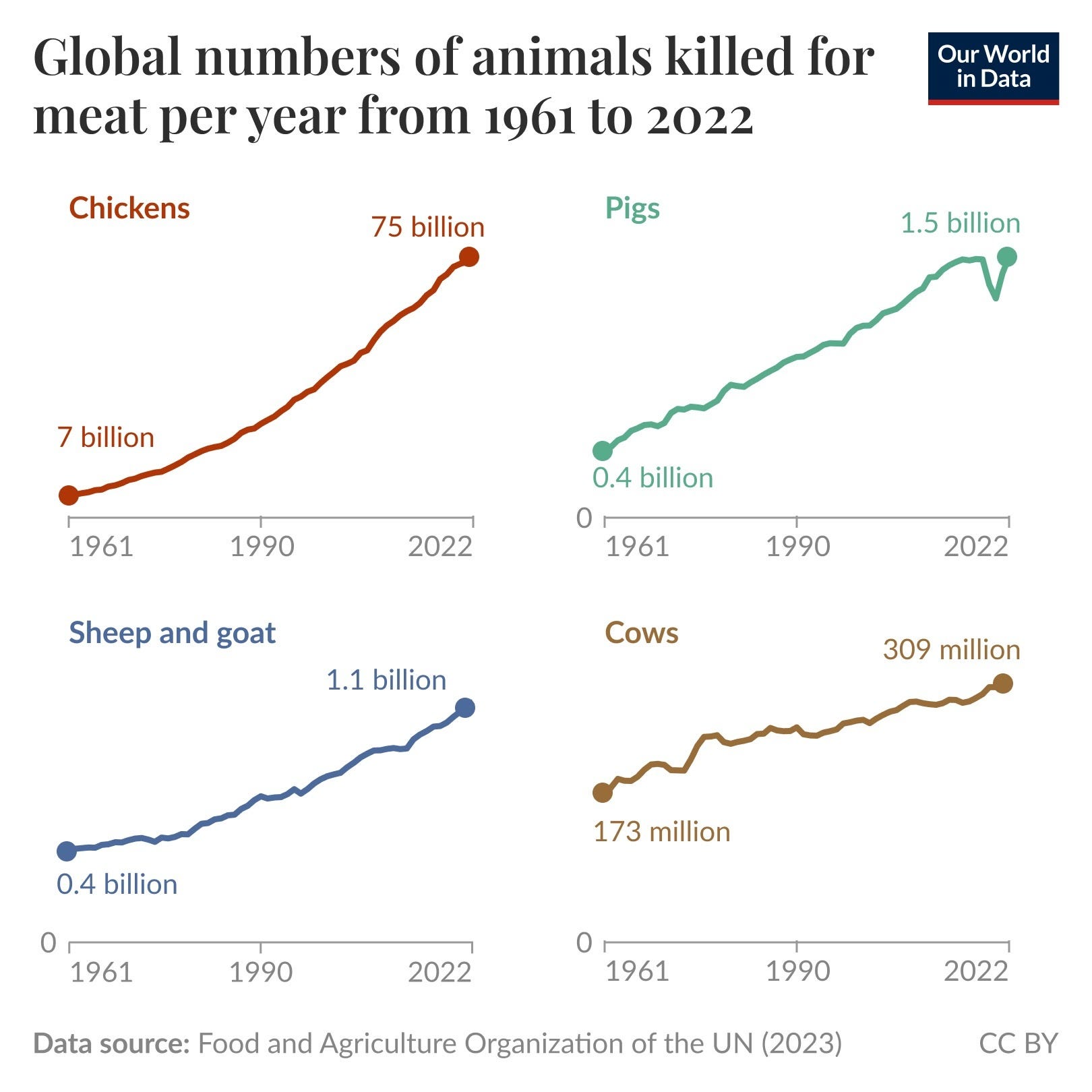
Animal advocates have been hammering away at the foundations of factory farming since at least the 1970s, the decade Peter Singer published Animal Liberation. And after half a century of protests, vegan outreach, open rescue, leafleting, and corporate campaigns, the factory farm industry is bigger than ever. We could say that growth in China and Africa is making up for all the animals we’ve helped in America and Europe, except the number of animals killed for food each year is still increasing in the U.S. and most European countries, not to mention Latin America and everywhere else. But hey, at least there are Impossible Whoppers™ at Burger King for the segment of the population who identify as vegetarian, even if that segment hasn’t grown since records began (actually, it has decreased globally thanks to secularization in India).
Basically, reader, the situation is dire. Worse. You could basically say we have failed. Granted, the fight isn’t over. We could still turn things around, right? But that’s not the question. The question is will we turn things around, and the answer is that if I was a sow being prodded back into a gestation crate for my sixth tour of duty, I would not be feeling very optimistic.
The problem is simple: factory farming is a very effective replicator. It produces something people want. Meat is delicious- at least, I know of no definition of delicious that stands up against “the vast majority of people enjoy eating it.” Meat is nutritious- ask any global poverty expert the first three things they would do to improve development outcomes in regions with high childhood malnutrition, and animal-source foods would be on the list. And lastly, factory farmed meat is amazingly affordable. Each serving of meat cost our Neolithic agriculturalists roughly three hours of labor; a burger from McDonald’s costs the median U.S. worker less than ten minutes, chicken nuggets included.
Billions of humans all around the world demand the cheap, nutritious, and delicious output of factory farms. And I mean literally demand - pundits love to speculate that a sharp enough spike in Chinese pork prices could lead to riots and perhaps even bring down the government; grocery prices may have cost incumbent Democrats the White House in 2024. Factory farming is not being inflicted on an unwitting consumer population; it is one of their most strongly and consistently revealed preferences.
Demand leads to profit, which is in turn used to grow the industry. There’s nothing mysterious about the growth of factory farming over the last 100 years; we don’t need to scry for conspiratorial explanations in corrupt government subsidies or ingenious advertising campaigns. It was the most natural thing in the world. It was the Law.
I fought the law
A few brave souls saw what was happening and hatched a desperate plan to stop it. It’s not that they didn’t understand the Law; their plan was based on it. They birthed a new replicator into the world, a conceptual virus engineered to target factory farming. It was the meme of animal rights.
Some of the most powerful replicators in the world have been simple ideas like this one. Spreading from mind to mind, redirecting their adherents, ideas have brought down empires, slain Gods, enslaved entire races and emancipated them. Could an idea bring down factory farming?
It was worth a try, but once again, reader, you know how the story ends. It’s not that it couldn ’t have worked; it just didn’t. Animal rights wasn’t nearly as potent a replicator as its target. It got, as the kids would say, mogged.
When I found my way into the animal movement, the first form of activism I did (like most people who joined in those days) was leafleting. My first shift was handing out leaflets about veganism to people lined up to see a talk by Jane Goodall. Primo audience, in other words. I spent an hour or so disbursing leaflets. Then, once the talk started, I spent ten minutes collecting those same leaflets out of the trash bin a few yards from where I’d been standing. Nobody engaged in this seemed to believe it was going to fundamentally change things.
A few months later though, still bright green, I came across Direct Action Everywhere. Here was something different. I hadn’t met many other activists, but these were the first to say that truly transformational change was possible, that we could end animal exploitation in my lifetime. They had a vague plan, but mostly it was just about ambition, about daring to pursue what you really wanted.
I’ve spilled buckets of digital ink (rearranged pixels?) explaining all the things I think we got wrong. But one of my most embarrassing mistakes, one I haven’t dwelt on here before, was that I assumed this audacity itself was something new under the sun.
It wasn’t. In the decades since Animal Liberation, plenty of people have dared to dream of a world without animal farming. They’ve all failed to make that world a reality, or even bring it one step closer. And before you try to get clever with me, I promise you there isn’t some other magic word people haven’t sufficiently incanted. Whatever you think makes your abolitionist movement special–“It’s grassroots! It’s radical! It’s decentralized! It’s intersectional! It’s based on social science!”–people have tried it before. The fact that you haven’t bothered to learn any of their names is not evidence that they didn’t try hard enough; it is only further evidence of how likely you are to meet the same fate.
Whatever our problem is, it is not a lack of bold declarations or abolitionist stratagems.
I can’t say for sure that the animal rights meme has been a total failure. Maybe things would be even worse if it had never been conceived. Maybe there would be even more factory farms.
If that’s the case, then yes, we could spend another half century banging our heads against the wall in the same fashion, and for our efforts, we could expect that on Animal Liberation ’s hundredth birthday, factory farming will be bigger than ever and growing, but less big and growing less fast than it would have been otherwise.
3. If you can’t beat ’em
" Thou art my hiding place; thou shalt preserve me from trouble; thou shalt compass me about with songs of deliverance." - Psalm 32:7
Or, we could call a tactical retreat. We could admit that our frontal assault on the citadel of Meat was hopeless from the start. We could go back to the drawing board and ask: how can we replicate more efficiently than factory farms?
Take that literally enough and you could have predicted the next chapter of our little history- and its downfall.
People want meat. Meat from animals involves terrible violence and suffering. But it doesn’t have to. In fact, there’s got to be an easier way. That is the thesis behind cultivated meat: real meat–the same exact product–without animals.
For years, cultivated meat has been a light in the dark for all those who see the suffering of farmed animals, a final insurance policy against our other desperate efforts. Few of us worked on it directly, but that’s because few of us had PhDs in bioengineering. So we general infantry kept slogging it out in the trenches, eagerly awaiting the latest news and rumors from our boys and girls back at Los Alamos.
The believers
How good that news is depends on who you ask. Working at the intersection of animal welfare and AI safety in San Francisco for the last few months, I’ve noticed a sharp divide on this topic in the Effective Altruist (EA) community. On one side are EAs focused on helping animals; on the other are those deeply sympathetic to animals but focused on other causes like AI safety and global poverty.
The latter group still has faith in the promise of cultivated meat. Heck, to them, it’s more than a promise; it’s a contract, with the signatures dry and the money in escrow. It is a guarantee inherent to the very Law, in particular its articles on thermodynamics.
Consider the chicken, that most numerous of farmed terrestrials. Chickens, as we have established, are, from the standpoint of ~all humans, delicious and nutritious. They are also sentient beings. This combination is extremely bad.
Besides being delicious and nutritious, chickens are very cheap. Most of the cost of raising animals for food is feeding them. Broilers convert 13% of the calories and 20-25% of the protein in a short lifetime of feed–mostly corn and soy–into edible meat, compared to 3% and 5% for a cow. When researching these numbers for me, Claude dubbed broiler chickens “by every metric, the most efficient terrestrial meat machine ever built.”
At these conversion rates, feed still accounts for two thirds of the cost of raising chickens, and 87% of those calories are not ending up as meat. Where do they go? Much is lost to the basic energetic costs of biology. Soybeans don’t turn into chicken breast by way of magic; the transmutation requires energy. But a lot of the difference is all that stuff that isn’t meat. The modern broiler chicken, genetically mutilated by seventy years of selective breeding, is about 55% human-edible meat by weight the day they are killed. The rest–bones, feathers, viscera–is byproduct.
Get rid of all that extra junk, and cultivation should be able to slash the cost of chicken meat by a third- even before we get around to improving on energy conversion.
Reinventing the chicken
So how’s it going? The soldiers on the front are dying to know.
Well, we’ve got stem cells, say, from a salmon. We can get them to replicate, such that we could serve you a nice lump of salmon stem cells, basically a sludge of gray mass that tastes like nothing. But it’s the first step! Good.
Next, we can trigger the stem cells to turn into meat cells. That’s… the last step? What else is there? Isn’t meat just cells?
Sure enough, at a few premier restaurants around the country, you could make a reservation tomorrow and treat yourself to a delicate morsel of cultivated sashimi. It’s a small portion at a steep price, but it’s just waiting for economies of scale to kick in. It’s a proof of concept, right?
Not so fast.
You’ll notice that sashimi is, by definition, a rather thin slice of salmon. That’s no coincidence.
Rewind back to the slurry of stem cells. If you turn them all into meat cells, they’re still just a slurry, like salmon flesh run through a high-powered blender. To grow a chicken breast anybody will want to buy, you have to replicate from meat cells, building the tissue cell by cell.
This requires feeding the cells. With a thin layer of cells, it’s relatively easy to deliver the necessary nutrients; just drop them into a bioreactor full of the right mix of medium. But as the tissue starts to build, we run into a problem: how can we get nutrients to the cells near the center of our new lump?
Not to worry. We know how nature solved this problem, and we already have the DNA to do it. We need to vascularize our chicken breast: that is, trigger the growth of a fractal network of vessels and capillaries to carry nutrients throughout the mass.
This alone turns out to be way harder. But say we’re able to vascularize the tissue; now we have a growing lump of chicken breast floating in a bioreactor full of growth medium, with vessels to carry the medium throughout the lump. Except the vessels being there doesn’t mean the medium actually flows through them, at least anywhere near fast enough to replenish the interior cells. We need to create asymmetrical pressure on our vessels, so the medium gets pushed in one end and pulled out the other. We need to wire every vessel up to an artificial heart pumping medium-blood through the tissue. We ’ve reinvented the circulatory system.
And what about the spent medium being pulled out of the breast? When it goes in, it’s full of glucose and oxygen; coming out, it’s polluted with carbon dioxide, ammonia, and lactate. If we feed these back into another chicken breast, they’ll be poisonous. We need to filter the medium continuously, maybe on every single pass. Now we ’ve reinvented the kidneys.
Speaking of which, when we filter out the bad stuff, we also need to replenish the good stuff. This is where cultivated meat is supposed to thrive. We just heard that feed accounts for two thirds of the cost of factory farmed chickens, and we’re saving on feed by skipping unnecessary chicken anatomy. Does that mean we’re just pouring 50% as much corn and soy into our bioreactor as it would take to grow a whole chicken? Well, no; our isolated chicken breast can’t make use of whole corn and soy. We need to digest it first, break it down into pharmaceutical-grade glucose and amino acids, then add a litany of growth hormones and other regulatory chemicals, which need to maintain a constant and delicate balance. You won’t be surprised to learn that this costs quite a bit more, calorie-for-calorie, than raw commodity corn, “roughly the cheapest edible biomass humanity has ever produced.” (That’s Claude again.) We ’ve reinvented the full digestive and endocrine systems.
It keeps going. Muscles need motion and exercise to develop properly; paralyze a fetus in the womb and the baby will be born terribly and permanently disfigured. To flex our muscle mass, we need electrical input - nerves. But if we just zap a free-floating chicken breast with nerve stimulation, it will lock up once and never unlock. We need to anchor it to something, to stretch it back out again- bones and joints, attached with ligaments. Sure, these can be metal bones that we don’t need to regrow for each chicken breast, attached by rubber ligaments, stimulated by copper nerves, but all of this is becoming a delicate engineering challenge, prone to malfunction and maintenance.
Which brings us to the worst part, the part that will send any veteran of a meat cultivation lab into cold sweats and flashbacks: the immune system.
The Red Queen
We non-biologists tend to badly underestimate just how much of our metabolic and evolutionary energy goes towards fighting off infection. Remember earlier, when we talked about tracing human migrations using genetic variation? Well, it turns out that the most variable part of our genome is dedicated to identifying and fighting off pathogens. Humans have spent most of our adaptive evolution on immunity, and it’s no wonder why: fighting off unfamiliar infections is even more costly. Children mounting an immune response have been shown to grow as much as 49% slower, their metabolic economy requisitioned for the war effort. As a result, populations in high-pathogen environments (think tropical jungles) who are regularly fighting off infections throughout childhood tend to be seriously stunted. (This is probably why proactively feeding antibiotics to animals in unsanitary farms makes them grow faster.) Sex itself is likely an anti-parasitic technology, and a costly one: the male half of all offspring in sexually reproductive species bear no offspring of their own, effectively halving reproductive output in an attempt to give the species an edge in our never-ending arms race against parasites. This is called the Red Queen Hypothesis, after Lewis Carrol’s red queen who has to run as fast as she can just to stay in the same spot. And sure enough, despite all this evolutionary effort, nearly half of all human children in history up to the invention of germ theory in the 1860s died from infections before reaching adulthood- and that’s when there wasn ’t a pandemic on, wiping out half a continent in the span of a few years.
The entire price war between cultivated chicken breast and whole chickens could rest on the immune system. A chicken in a factory farm wastes precious calories producing five billion or so immune cells per day, and that’s during peacetime, when they aren’t actively infected. If cultivators could find a way around the immune tax, that might be their best chance to undercut the feed-conversion ratio of factory farms.
Will we be able to outperform nature? We’ve done it before. Evolution has been optimizing flight for hundreds of millions of years. Within a century, humans crushed its best records on size and speed, with jets rocketing hundreds of passengers between continents in a handful of hours- at a cost of over 2 million calories per passenger in jet fuel, the equivalent of three years’ worth of food. We’re still nowhere close to a drone that can make an intercontinental trip with the energy budget of an albatross, or fly any distance with the agility of a starling, qualities that proved much more valuable in the evolutionary context.
Evolution did not care about all goals equally. In areas evolution wasn’t optimizing for, we should expect it to be relatively easy to surpass. But beating evolution at its own game will be another thing altogether. (Hold onto this principle; we will return to it later.)
Well, reader, there is plausibly no single target that has earned more attention in the four-billion-year evolutionary epic culminating in the modern chicken than fighting off infection. We should not be surprised that it is hard to beat.
Meat cultivation labs are some of the most tightly biologically controlled environments on earth. Designing and building a single test-scale clean room to this level of tolerance costs millions of dollars. Building one on the scale of a single factory farm has never been done, in any industry; the largest facility yet, built by Believer Meats at a cost of $123 Million dollars, aims to produce in a year what an ordinary broiler slaughterhouse handles in a few weeks. At least that was the plan; construction finished late last year, but the plant has been quiet since, perhaps because ongoing production costs are projected at five to ten times commodity meat prices.
Even on the laboratory scale, contamination has been the defining catastrophe of the industry. A single invasive cell can kill off one cycle of an entire bioreactor, no matter how large. That means biorisk scales up linearly with facility size- the opposite of an economy of scale. If we can’t solve this, the cost per pound of cultivated meat might increase the more you try to make.
We have not, I am sorry to say, reinvented the immune system. If we ever do solve it, it will probably look like a combination of engineering and cellular immunology- that is, we’ll need both expensive biosecure facilities and a metabolically-powered immune system operating inside the bioreactors themselves. The latter will cost calories, just like a chicken’s, except that–as we established before–the chicken’s calories come much more cheaply.
If you can’t join ’em
Imagine some visionary scientist had conceived of the idea of chicken breast without ever hearing about the existence of a chicken. She was trying to invent meat from scratch, from first principles, from a single cell. She sold investors on a biotech startup promising a new type of cheap, delicious, and nutritious food.
After years of research costing hundreds of millions of dollars, she managed to reconstruct the circulatory, digestive, endocrine, renal, skeletal, and nervous systems inside a tightly controlled bioreactor fed with pharmaceutical-grade medium. But she had run aground on immunity, driven to desperation as batch after batch was soiled by otherwise undetectable microbes, the problem only getting worse as they tried to scale up. She’d drawn up plans for a large facility that could produce breast at just five to ten times the cost her taste-testers said they’d be willing to pay, but that was if everything went perfectly, and nothing ever did.
Then one day, a man arrives at her laboratory, dressed in strange clothes, carrying a large, mysterious box draped with a sheet. Wordlessly, he hoists the crate up onto the table in front of her, and pulls back the sheet, revealing a wire cage containing a single chicken. In a mysterious flash of insight, she sees it all: bones, feathers, feet, beak, crop, stomach, liver, kidneys, intestines, cloaca, heart, lungs, all of it meticulously orchestrated to turn corn into chicken breast with the efficiency of four billion years of optimization. It even walks around feeding itself. As she breaks down in rapturous tears, the mysterious man explains that you can lock a few thousand of them in a simple shed made of corrugated sheet metal, throw in a few handfuls of corn every now and again, and despite shitting all over each other until the air is thick with ammonia, despite being incapacitated literally because they turn corn into chicken breast at such an unnatural speed, somehow most of them still survive long enough to reach slaughter weight. Oh, and by the way, all those extra parts besides the meat? You can sell those too! Bones, guts, they can all be used for pet food and other products. There’s even a market for feathers.
(If anyone had watched this video, they could have forseen what would happen with cultivated meat.)
The chicken would seem to her like nothing short of a miracle- clearly the best way anyone could come up with to turn corn into chicken breast. Maybe the chicken could be improved on–indeed, he interjects, it has been, through selective breeding–but only a fool would start over from scratch.
Perhaps, then, the scientist from this meatless world would learn the chicken was capable of pain, and not just of pain but of yearning, of joy and play, and she’d be like “What the fuck dude, you torture and murder these just to eat them? Get out of my dimension you sick fuck.”
Well, that would be nice. Unfortunately he would then return back to our dimension.
See, reader, I know you. I know what you’re thinking at this point. You’re thinking:
So what if all we can get is two-dimensional meat sheets. Just stack them up! So it costs more. It’s a small price to pay for sparing animals from a lifetime of torture.
But the consumers who will decide whether to switch to cultivated meat don’t see it that way, because they don ’t care about chickens literally at all. Not only are they not willing to pay a penny more for cultivated meat; if it cost the same, most of them would still choose “natural” meat from animals. Many would choose to keep eating animals even if cultivated meat were substantially cheaper!
At least, that’s what they say in surveys now. But maybe they’d adapt once it was available? It’s not at all obvious they would. Consider people who pay for organic produce when it’s neither better for the environment nor for their health. Organic produce is just some vibes-based bullshit! Fuck, even I buy it sometimes! I know it’s stupid and pointless–I know it’s fertilized with manure and gore from factory farms instead of fossil fuels–but somehow when I’m in the grocery store, some dumbass part of me still takes control and chooses to spend twice as much on some random organic produce because the idea that food should be “natural” runs so goddamn deep in my psyche.
The new science
If the situation is this bad, why are there still any cultivated meat enthusiasts? Or you could ask, given there are still believers in cultivated meat, surely I’m making things out to be worse than they really are?
Lets come back to my EA friends. I mentioned there’s a split between EAs who are focused on animal advocacy, and those who are sympathetic to animals but focused on other causes like AI safety or global health and development. The latter group confidently believe that cultivated meat will soon be solved, and factory farming will inevitably end. The former don’t take this for granted at all, and worry it is less likely than not.
I see a few obvious ways this schism could form. One is that people who believe factory farming will inevitably be replaced by technology choose to work on a different problem. Another is that animal advocates engage in motivated reasoning out of a need to believe that all our hard work matters, and won’t just be supplanted by technological progress.
Acknowledging these possibilities, I fear a third answer: cultivated meat sounds great from a distance, but the closer attention you pay it, the more uncertain it looks. Nothing has done more to dampen my enthusiasm for cultivated meat than talking to people who work or have worked in the industry. They consider it somewhere between a long shot and a fool’s errand. I hope the experts are wrong, but hope doesn’t help animals.
That said, many of my EA friends have talked to the same former researchers, heard the same grim tale, and they are still optimistic. Heck, they’re downright dismissive of any doubts. These are smart people, and you might want to trust them more than me. Before you decide to do that, there’s something you should know about them.
These optimists share a worldview about technology that is, shall we say, not exactly mainstream. Among them, it is taken for granted that superintelligent AI will soon lead to “a century of technological progress in a decade.” That is, you should try to imagine what technology we are currently on track to develop by the year 2130, then assume that it will instead appear by 2040. We’re not talking about flying cars and lifelike virtual reality video games; we’re talking about extreme technological maturity, the stuff of hard science fiction: adult human brains uploaded into computers. Space colonization, with self-replicating interstellar probes the size of a tennis ball seeding digital civilizations the size of a solar system. Brain tumors surgically excised by microscopic robots released into your bloodstream without having to cut open your skull. Human immortality, and perhaps human resurrection. A few decades after these things, maybe we tunnel into other dimensions. Or maybe we make subtle modifications to our universe’s physical constants by coaxing its false vacuum to decay into a slightly more stable one.
I regularly meet people who fully expect AI to manifest all of these technologies by the middle of this century. Compared to these, cultivated meat seems like child’s play. These techno-optimists know that it is floundering now, but that’s simply because we aren’t far enough along the tech tree, and that’s going to change soon. We’re like Leonardo da Vinci trying to design a flying machine before the industrial revolution.
And yet, I confess, reader: I also expect all of these technologies as a result of the AI revolution. And I’m still doubtful that cultivated meat will ever replace factory farming.
Imagine you and I were sitting in England in the mid 19th century wondering whether the budding industrial revolution would unlock the powers of flight. We might pore over Leonardo’s old diagrams of winged contraptions, wondering whether new materials like steel or energy sources like coal and the steam engine could address their limitations. Maybe in the end, we would make a bet; I’d bet there was no way to give a man wings, you’d bet that we just couldn’t see it yet.
A flapping wing from da Vinci’s notebooks
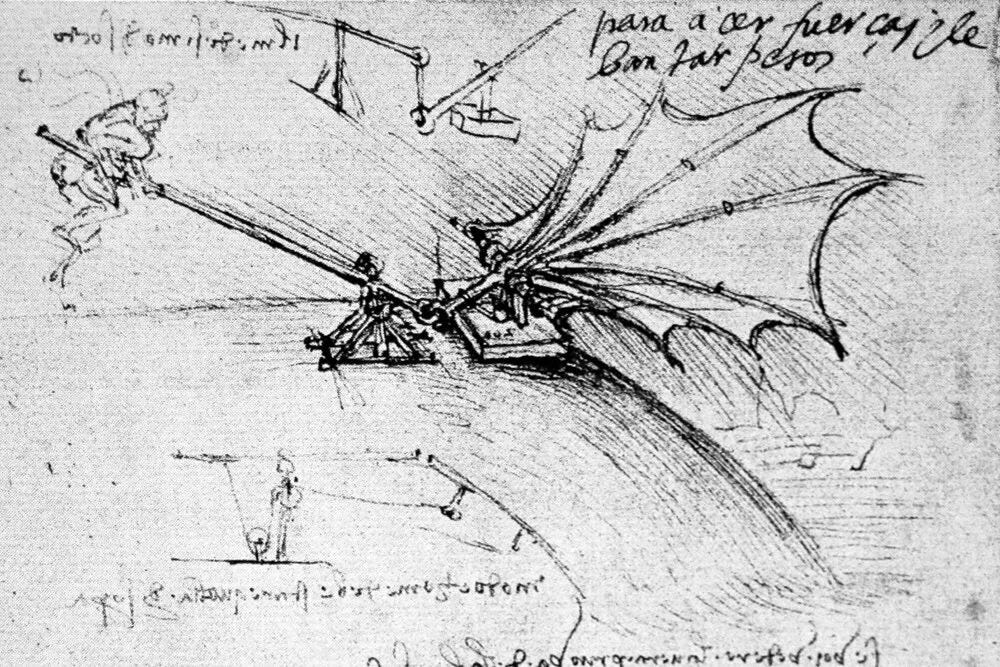
Which of us would win? Industrial power did eventually bring about flight- but not in the way either of us was imagining. And it’s not just that the technique is different, that in all our thoughts of flapping wings we never conceived of the propeller engine. The whole nature of the thing is different. Leonardo was imagining commuting around Florence on his pedal-powered helicopter; we still take the bus. I’m pretty sure he never imagined a passenger jet blasting hundreds of tourists from Florence to San Francisco between breakfast and dinner. You would win the bet only if you had defined it sufficiently broadly.
The tech tree winds unpredictably. Like a bottled genie, it grants our most magical wishes, but rarely in the ways we imagined them, and often with unexpected costs. The history of science is littered with the forgotten names of researchers who were sure they knew what the solution would be; the unexpected costs of the real solutions have filled cemeteries.
I’m sure AI will solve some of the problems facing cultivated meat. But it will also accelerate factory farming! Genetic engineering could make chickens grow even faster or make corn even cheaper. Robotics could slash labor costs in farms and slaughterhouses. And advanced engineering could solve any challenges to bringing factory farms into space or to other planets. To close the gap, AI would have to help cultivated meat much more than it helps factory farming, despite the factory farm industry having much more money to spend on AI R&D. It’s not enough for cultivated meat to be possible; helicopters exist, but we don’t use them in our daily commute because they are pointlessly expensive to fly, and why go through all the trouble? And this is before we get to the fact that most consumers say they would prefer meat from animals even if it were more expensive. To replace factory farms, we need something cheaper and more appealing.
We need a better replicator.
4. Catabasis
" For I desired mercy, and not sacrifice." - Hosea 6:6
If you’ve taken me for a pessimist, that would be an understandable mistake. But no, reader. I believe that technology will deliver us what we want, if only we remember to define our desires broadly enough:
We want meat without suffering.
We want meat without suffering, because if we don’t get it, people will keep demanding meat with suffering. Ideas alone, however righteous, have not been enough to quelch their demand. There may be no lab-grown miracle coming to sate it either.
What if we ’ve been working backwards?
Maybe it should have been obvious from the outset. Maybe it was, to some.
Let’s go back to first principles. What we want is a chicken breast. What we don’t want is a lifetime of misery and torture. Which approach is more promising?
Start over from a single cell, building our way towards the breast, reinventing one critical system after another in a tightly controlled laboratory setting; or
Start with the chicken, and remove the suffering.
A couple decades ago, either of these might as well have been magic. Today, only one of them is. That’s due partly to technology, but mostly to simple economics: the first option, like the animal rights meme, attempts to fight against the extraordinary efficiency of factory farming, while the second flows along with it.
We will now get a clearer view of this by climbing up the technological ladder. By the end, you’ll see the best reason you’ve ever had to hope for transformative change for animals. But we need something to turn that hope into reality: you. We need founders. The money is there. The ideas are there. And by the end of this section, hopefully you’ll be there.
Fair warning: you are probably going to hate this. That is approximately the point.
We all make sacrifices for the movement. We lose our blissful ignorance, forcing ourselves to confront the dark reality of factory farming. We give up our nights and weekends volunteering, or working overtime for negligible salaries. Some go further. I have friends who’ve spent years in prison; I’m currently facing a battery of felony charges for allegedly rescuing beagles.
I ask much more from you now. I ask you to let go of your moral purity, to take those pristine hands of yours and use them to make a difference in the lives of animals, letting them be stained with blood in the process. In fact, it’s better to think of ourselves climbing down the ladder, leaving behind our comfortable moral high ground, like Orpheus descending into the underworld to negotiate with its ruler for the return of his lost love.
Rung 1: Extrinsic welfare tech
Whence cometh suffering in the life of an animal on a factory farm? Think of the worst horrors you’ve seen, the ones you would rely on to convince a stranger at a vegan outreach event. What makes them bad?
First and foremost, physical pain. Pain comes from mutilation, from teeth, beaks, tails, testicles being sliced or torn off with no anaesthetic. It comes from the broken brittle bones of laying hens whose calcium has all gone to laying too many eggs, from lame broiler chickens collapsing under their unnatural weight. It comes from wounds sustained in fights with other animals, driven to insanity by the horrors of their lives; wounds that then become infected and necrotic in the petri dish of a factory farm. From being slowly devoured alive by sea lice, or cannibalized. And of course, it comes from being sliced apart in your final moments, or suffocated, scalded alive, or frozen to death, all fully conscious.
Then there are physical discomforts other than mutilation, ranging from annoying to extreme. Hunger, whether due to lameness or to genetically optimized insatiability. Thirst, as well. Rashes, sea lice, bacterial infections, parasitic worms. Fevers and respiratory infections of all severities, including deadly. The ache of muscles that urge to move beyond the extreme confines of your cage.
That’s a taste of the physical torments. It may well be that most suffering is more psychological. Sitting in an airplane seat for a couple hours is perfectly tolerable; spending weeks or months there might be enough to drive the most well-adjusted person to the brink of psychosis. If behavior is any judge, then the baseline for animals in factory farms is a continuous roller coaster of anxiety and despair.
This is hell on earth, and taken as a whole, it feels overwhelming. But that’s true of any big problem. The first rule of effective management is to decompose any problem down into its component parts. Try thinking like an engineer. Do any of these problems seem remediable?
Think of five technologies–even things that already exist–that could be deployed as harm reduction strategies in factory farms. But remember, they can’t be too expensive, or farms that adopt them will lose out to farms that don’t. That’s the Law. In fact, the best solution would be something that increases the profitability of the farm just so, enough to cover the cost of installing it.
Nobody understands this better than Robert Yaman, the founder of Innovate Animal Ag. He explains:
[AI-powered monitoring] tools could, in theory, help the farmer detect and identify sick birds earlier… But it wouldn’t solve the brutal economics of poultry health management.
Suppose you have a condition that kills 0.1% of the chickens in your 40,000-bird barn (40 birds in total). At $4 of economic value per bird, the condition costs the farmer $160 per flock. To break even on a treatment, you’d have to dose all 40,000 birds for less than 0.4 cents apiece. Once you account for management overhead, manufacturing costs, and any uncertainty about efficacy, the real ceiling is lower still. Most likely, given current economics, this condition would go untreated, and the mortality would be considered a necessary if unfortunate cost of doing business.
Now suppose that you could treat only the birds affected by the condition. Suddenly the budget is $4 per bird, a 1,000x difference! This still might not sound like a lot, but pharmaceuticals often have significant pricing flexibility based on the cost-sensitivity of the target market. With this new economic equation, many existing drugs that are currently priced out of poultry come back into reach, and entirely new ones become worth developing.
Robert’s example also highlights the implicit alignment between factory farms and animal advocates when it comes to death before slaughter. Every animal who dies prematurely is wasted money for farmers; it is also an extra life of misery that could have been spared. If there is enough demand for one million salmon, and twenty percent of them die before slaughter, farmers will hatch 1.25 million. Eliminating mortality in that farm would be the equivalent of decreasing demand for meat by 20% in terms of misery spared.
That is the mathematics of __ welfare engineering: solving technical challenges that make factory farms less awful. It might involve spotting low-hanging fruit on the tech tree, technological innovations that wouldn’t cost much to develop from our current level of advancement, but which nobody will choose to invest in for profit motive alone. Or it might mean applying existing technologies in novel ways that farmers haven’t figured out yet, out of habit or ignorance, or because it would cost them just a little and they need a nudge in the right direction.
The space of opportunities here is wider and deeper than you think. Here are my five favorite opportunities ranging from affordable to profitable, from novel to familiar, covering all manners of misery in factory farms.
1. In-ovo sexing
Problem: Male chicks are useless to the egg industry. Live chicks are sorted after hatching and the males are blended alive or gassed.
Solution: Using medical imaging or hormone sampling, sort out male eggs before any possibility of sentience develops.
Cost: Less than one penny per egg and falling. If up-front installation costs drop low enough, it could theoretically generate savings by not incubating useless male eggs. Plus, positive PR.
Status: Increasingly common in Europe, and gradually rolling out in the US, Brazil, and Australia, sparing hundreds of millions of chicks. In the rest of the world, this is just waiting for someone to lead it. Adoption in China may be particularly promising thanks to a consumer market for partially-incubated eggs. (I’ll spare you a photograph, but while it looks bad, it’s unlikely the fetuses have anything like sentience.)
2. Sea louse lasers
Problem: Salmon in cramped aquatic farms are plagued by sea lice, tiny crustaceans that latch onto small wounds and start eating them alive. It’s common for farmed salmon to be swimming around with large holes in their body or head. The treatments the industry currently uses are a welfare catastrophe of their own: thermal delousing (hot baths) or mechanical delousing (sucking salmon through a maze of pipes) both cause terror and mass mortality. Other farms install “cleaner fish” who feed on the lice, but these cleaners lead miserable lives of their own and only add to the body count and chaos of the farm.
Solution: Exactly what it sounds like. Submerged cameras watch for individual lice and pulverize them individually with space ocean lasers.
Cost: Sea lice are a serious problem for salmon farms. The current mitigations have their own costs, including high mortality. Farms would be willing to pay a reasonable amount for a better solution.
Status: The first 1,000 units are operational today in Norway; needs further technological refinement and industry outreach to scale up.
3. Aquatic stunners
Problem: Fishes and crustaceans are killed by slowly suffocating in a pool of ice, fully conscious.
Solution: Electrical or percussive stunners render them unconscious before slaughter, or robotic slaughter lines deliver a quick death by stabbing into the brain.
Cost: Normal stunners deliver no economic benefit; robotic killing supposedly improves meat quality by reducing stress hormones, but the market for improved meat is probably small.
Status: Deploying stunners across the seafood industry combines an engineering problem (making effective stunning as cheap as possible) with a market shaping problem. Shrimp Welfare Project has been working on stunner tech to address the first. For the second, they started by paying early adopters to install machines, hoping this could establish stunning as a standard. (Though paying for stunners to be installed has been a trivial cost for already sparing billions of shrimps a horrible death.) This year, the International Council for Animal Welfare ran the first corporate campaigns on the subject, convincing European grocery giant Aldi to commit to ensure stunning is implemented across their Shrimp supply chain by 2035. Grocers in other parts of the world, and every other aquatic species, are waiting for their turn.
4. Ozempic for chickens
Problem: Broilers have been bred to eat themselves to death’s door before slaughter at six weeks, but the birds used for breeding are kept alive for 60+. They’re kept on an intense diet with only 50-75% of the calories they’d consume voluntarily. They spend their entire lives in a famine.
Solution: Administering GLP-1–the hormone Ozempic mimics–reduced voluntary feed intake in chicks by more than 50% in a preliminary experiment.
Cost: The cost is the drug itself. Much less would be needed if it could be administered by injection instead of in the water supply; that would likely require an effective robotic dispersal mechanism. Though with semaglutide going generic in major markets this year, the cost may fall so far that it wouldn’t be necessary.
Status: Early stage. Trials needed. Very promising.
5. Disease mitigation
Problem: Many of the worst ailments of factory farmed animals originate from pathogens: a bacterial leg-joint infection disease called BCO painfully cripples or kills hundreds of millions of broilers annually. Bird flu leads to painful deaths–by the disease itself or by horrific culling methods like being steamed alive–for hundreds of millions more. All of these animals are replaced by other animals, meaning more total animals need to be born.
Solution: Literally just vaccines. Innovate Animal Ag is helping bring a BCO vaccine to market that has shown a 50% reduction in lameness. France deployed a bird flu vaccine across their duck industry and slashed outbreaks by 97% in one year. Complement this with Far-UVC, the same technology proposed for slowing human epidemics by sterilizing the air in public spaces, dishing out long-range UV rays that are strong enough to zap bacteria and viruses without harming animals, human or otherwise.
Cost: Massively cost-saving for the industry once developed and approved.
Status: Often trade and regulatory hurdles stand in the way rather than basic economics, such as with the U.S. currently dragging its feet on a bird flu vaccine. We need both R&D and lobbying capacity to bring more new vaccines online.
–
This is just scratching the surface. The list goes on:
Immunocastration: Baby piglets have their testicles cut or torn off by unskilled workers; no vet, no painkiller. A two-dose vaccine could biologically neuter them instead, sparing them painful mutilation while still reducing aggression and agitation between males. This actually makes money for farms; because the testes function a bit longer, male pigs grow more muscle, as much as an extra $15 per pig in one setting. This is standard practice in Brazil and Australia, but the method has stalled in the U.S. and EU.
Enrichment tech: robotic toys to provide stimulation. Chickens enjoy laser pointers just like cats, and farms would be willing to install them because play could improve meat quality.
Robotic handlers: it might sound dystopian to have robots replacing humans in farms and slaughterhouses. But robots by default would cause less stress for chickens, and it’s not hard to imagine them being more gentle than untrained minimum wage workers with anger management issues.
Precision Livestock Farming (PLF): on a similar vein, using AI to closely track individual animals could easily lead to better care. It’s not even clear PLF would be negative by default; that contract I mentioned earlier between Muyuan and Qwen might already be a good thing.
Infrared beak removal: instead of searing sensitive beaks off with a hot knife–often leading to chronic pain–infrared stunts the beak causing it to slough off after a few weeks. Less pain, no open wound.
Feed fortification: laying a freakish number of eggs leeches more calcium than hens’ bones can spare. Better mineral formulations along with split feeding (waking birds up in the middle of the night to feed) would cost pennies and prevent agonizing keel bone fractures (akin to breaking your sternum). Feed optimization across different species could address a wide range of maladies.
Controlled-atmosphere stunning/slaughter: electrical stunning requires stressful handling by humans, and CO2 slaughter is a slow, painful death as carbonic acid burns your eyes and lungs. Stunning with argon gas is painless, and could be done before being unloaded at a slaughterhouse- or potentially even before leaving the farm. It’s mostly an engineering problem, including finding a cheaper way to source or recycle argon.
Valium for chickens: if we can pharmacologically suppress painful hunger, why not anxiety and depression? Heck, maybe chickens in the future will be blissed out on the avian equivalents of MDMA or ketamine; for now, we could at least disburse NSAIDs through their drinking water.
Lighting: just install windows. 🪄
And all of this is playing with two hands tied behind our back. After all, we’re only on the first rung.
Still, how far could this much take us? Let’s try to imagine the most welfare-optimized broiler farm of 2050.
Day one, chicks hatch in the barn. (They’ve been shipped from the breeding facility as eggs rather than as day-old chicks.) They’re in an enclosure about one square meter, with just a dozen or so other chicks. Their mother stands vigilant in the center, cooing individual names to each of them. So she’s a motionless doll with a speaker and a heat lamp; nestled under her polyester wings, they feel safe.
Their bodies grow fast, and gradually some of the walls recede, introducing them to a wider space full of other chickens. But their growth doesn’t hurt, and their new neighbors don’t make them angry. Actually, they feel pretty calm. Sometimes they like to play with each other or chase robotic toys, but usually after a nice meal they’re content to just chill out. (They never wonder about the causal link there.)
They never see a human. It’s rare they get sick, but if they do, the computer individually tracking all their vital signs knows before they do and hits them with a dose of whatever they need. Every night as the sun is going down, they hear their robotic mother calling them back, and they retreat to their home enclosure.
And that’s it. One night their pen fills with argon gas, and they never wake up.
Have we engineered our way out of the moral catastrophe of factory farming? If I was certain of that, there wouldn’t be three more rungs. This vignette is technologically within reach, but it’s not clear yet whether farms like this could produce as cheaply as farms that don’t prioritize welfare.
There is some chance that they don’t have to. I claimed earlier that consumers don’t care about chickens, at least not enough to pay more for cultivated meat. But this is one dimensional. While consumers are grossed out by cultivated meat and fundamentally don’t believe that there is anything wrong with eating animals, Robert makes the case that consumers would be willing to pay a premium for higher welfare meat, if they could trust the information available to them about which products had higher welfare. Vital Farms has become the second largest egg brand in the United States by revenue by charging three to four times the cost of a typical battery cage egg, in exchange for a high-welfare signal consumers trust (rightly or wrongly).
This consumer segment is real, but Vital Farms’ market position overstates its size- by definition, their market share by revenue overstates the share of eggs sold compared to commodity eggs by a factor of three or four. However, if AI leads to a post-work utopia, maybe that consumer segment will grow? If everyone is materially wealthy, surely they’ll be willing to pay an upcharge for high welfare.
To predict this, we might turn to what economists call the Alchian-Allen effect. This effect states that when the cost of an entire product category goes up by a fixed amount, the relative price difference between basic and premium products goes down, and consumers are thus more willing to pay for the premium version. Say conventional apples cost $1 and organic cost $2; only people willing to pay twice as much (for some godforsaken reason) will buy organic. Then the apple pickers go on strike, inflicting a uniform $1 price increase across all apples; now conventional are $2, and organic are $3. Suddenly the markup is only 50%, and more consumers are willing to buy organic. Thus, counterintuitively, as the price of all apples rises, a higher share of people get duped into paying for premium organic apples.
What about high-welfare eggs? Alchian and Allen predict that consumer behavior will be dictated by the relative change in price. If new technologies uniformly reduce the cost of both battery-caged eggs and eggs from our super welfare-optimized farm, the relative markup of welfare will increase. Technology needs to cut the cost of welfare even faster than it cuts costs for the cheapest, cruelest baseline. We should do everything we can to make that happen, but it may be largely up to latent technological potentialities outside of our control.
I’m afraid we shouldn’t put all our eggs in the welfare tech basket.
The limits of extrinsic engineering are partly due to incentives- or maybe I should say competing interests. Animal advocates want less suffering; animal agribusinesses want higher profits. The public and regulators want… well, they’re more complicated. They want cheap meat, but they want it to be “natural”, according to a highly idiosyncratic and status-quo-biased notion of “natural” that is (by revealed preference) perfectly fine with battery cages but says “big yikes” to welfare-boosting vaccines. Regulators try to balance the interests of the public and the industry while injecting a few of their own.
We can map all these techniques out based on which groups are in favor:
To me, the most striking thing about this diagram is the fact that there are items that both animal advocates and the industry want, but not the public. That is, there are meaningful welfare improvements where the industry would be our ally, and it’s the public or regulators who need to be brought around.
Another is that currently, the public and the industry are basically getting what they want, and animal advocates aren’t. It’s actually kind of misleading to represent this as three circles of the same size; animal advocates should be a tiny circle. Given how small we are, the fact that we’ve won anything (like progress on cage- and crate-free) is extraordinary, but the strategies behind those wins are themselves revealing. We are like a middle power caught between two warring empires. We can’t force things through on our own. We can only seek to partner with one of the other circles when our interests align.
We could align more of our agenda with the industry by making things cheaper. AI will help with that, both by designing new techniques and by enabling precise tracking of individual animals. But just because AI can do it doesn’t mean it will happen automatically. People will need to spend time setting up experiments, running trials, and pushing for regulatory clearances.
In the end, though, engineering the environment of factory farms is limited not only by incentives. It has another, deeper limitation: many of the worst sources of suffering on modern farms are intrinsic to the animals, products of the enormous genetic pressure to which we have subjected them in order to increase yields. To address these, we’re going to have to keep climbing lower, down into the genes themselves.
Rung 2: Breeding for welfare
Earlier, when comparing technology to evolution, we encountered the principle that, since evolution has had such a long time to operate, we should expect it will be hard to beat its performance on those features it cared about most. The race between pathogens and immune systems is such a feature, frustrating our efforts to cultivate meat without an immune system.
But this principle cuts both ways. It also tells us that for traits evolution did not exert pressure on, it might be relatively easy to outperform our inheritance.
This goes double when the technology we’re manipulating is evolution itself. This isn’t science fiction; we’ll get to that in the next rung. We’re talking about one of the oldest technologies known to our species.
Humans have been selectively breeding animals for something like 20 thousand years; nature has been at it for about 600 million. Now, ask yourself, which traits did evolution exert the most pressure on during that time? We’ve already listed several: energy efficiency, immunity, and above all fecundity, the conversion of calories into offspring, have probably been pushed near biological limits.
That leaves a lot of low-hanging fruit for genetic optimization by an intelligent designer with a different set of incentives. One such is intelligence. For most of evolutionary history, intelligence was treated as a costly inconvenience, a necessary evil; because of how many resources complex brains consumed, animals were in an evolutionary race to get by with as little intelligence as possible. Humanity’s ancestors stumbled onto the high intelligence strategy like a board game player who puts all their skill points into some weird asset that nobody else was taking seriously. It made our heads so big we had to be born prematurely and can’t even walk for like a whole year; not hard to see why nobody else went with this approach.
From a reproductive standpoint, it worked out. Our brain-first strategy led to a short period of compounding intelligence, but before long, we developed just enough intelligence to build complex technological societies, largely freeing ourselves from selection pressure as we knew it. It seems unlikely that we happened to reach close to the biological or physical limits of intelligence before this happened, implying a much higher ceiling on intelligence that could be reached through further selective optimization, whether on humans or machines.
But that’s enough about humans; what about domesticated animals? The first animals we domesticated were dogs, starting between 15,000 and 30,000 years ago. I’m not sure how long it took, but our ancestors definitely proved that evolution had not been optimizing wolves for slavish loyalty to humans; they were able to breed this into dogs without knowing what the hell they were even doing.
More recently, we’ve learned that evolution did not optimize chickens for growing the largest breasts in the shortest possible time, or for laying the most eggs; agricultural genetics companies have made massive strides in these areas in a short time.
Now, reader, what about happiness? General wellbeing? How useful were positive vs. negative affective states in the evolutionary environment?
We all know what physical pain was useful for: motivating our ancestors to avoid bodily harms that could erase their chances of reproducing. The same goes for hunger, thirst, etc. Enjoyable physical feelings are just the opposite, a reward for doing things that increase your reproductive potential.
With enough time–which there definitely was–we should expect these evolutionary signals to converge on a mathematical optimum. Things should hurt in proportion to the amount they reduce your chance of reproduction, and feel good in proportion to the amount they increase it. No meal can increase your reproductive odds as much as, well, reproducing, so no meal is as pleasurable as consensual sex- unless you’re on the brink of starvation, in which case eating could unlock a whole lifetime of reproductive opportunities; that meal should beat the best sex of your life.
Now I ask you: on net, would this evolutionary mathematics favor pain, or suffering? What should we expect to find if we add them all up over the course of each life, or across the sum of all lives?
The obvious answer might seem like at least zero; things should balance out. I think this is wrong.
Try to see things from evolution’s point of view. (OK, evolution is a blind idiot god, it doesn’t see anything; still, try to empathize with whatever senses it does possess.) From that vantage point, what good are contented organisms? They don’t do anything to improve their odds of reproducing; they just sit there. Worthless!
No, contentment is only useful as a lure. Evolution wants to give its organisms just enough contentment to know it is possible, then pull it away, dangle it out in front of them so they will chase after it, leading them in the directions it wants them to go.
There are countless things in nature that can wipe away your reproductive fitness in a short time. A pack of hyenas tear you limb from limb; screwworms infest an open wound, devouring you from the inside; a bacterial infection spreads through your blood, slowly annihilating you; you slip and fall down a ravine, breaking your legs and starving to death.
Almost nothing can double your fitness in the same amount of time. One sexual act doesn’t come close. Being rescued from the ravine, fed, and having your legs put back together might come close, if it had ever happened in our ancestral environment.
There is a common belief that widespread anxiety and depression today must be some kind of maladaptation to modern life, a mismatch between our evolutionary conditioning and our new social environment, our removal from small tight-knit communities into a vast impersonal society. Nature, the thinking goes, would never design beings that are just miserable by default.
No, man, that’s exactly what nature did! Anxiety isn’t a mistake, it’s nature’s first resort for motivating you. Anxiety is the feeling that you might lose something if you don’t act; depression is a blunt tool for teaching you to act differently next time if you did lose something. As psychiatrist Randy Nesse explained in an interview on 80,000 Hours:
[You might think] natural selection would shape us for health and happiness and cooperation and long, happy lives… once you start studying how evolution shapes behaviour-regulation mechanisms, you realise that it doesn’t give a damn.
Imagine you’re getting water for your family at the watering hole on the savanna, and it’s evening and you hear a noise behind a rock… Pretend that the cost of running is 100 calories, and you always get away free. And pretend that if you don’t run, you are eaten by a lion, and that’s about 100,000 calories. The ratio is about 1,000 to one. Whoa. So that means that anytime the noise is loud enough to indicate the probability a lion is there is greater than one in 1,000, you should run. And that means that 999 times, a normal reaction will be a false alarm… These systems are shaped to give off many, many false alarms.
From a standpoint of evolutionary incentives, it’s a miracle that any of us is anything other than a ball of fear and anxiety!
Generating mercy
All of this is good news for helping farmed animals. Pain, anxiety, and depression–the fundamental machinery of misery for animals in factory farms–aren’t just accidents of evolution, they are its key instruments, tools it has optimized over the course of millions of years. I said it would be easy to improve on things evolution wasn’t trying to improve on, but what about going in the exact opposite direction? That should be even easier. Destruction is easier than creation; all we have to do is smash nature’s precious little torture devices into a thousand pieces.
To this day, animal genetics companies are selectively breeding farmed animals to try to increase their profitability: how fast they grow, their resistance to common pathogens, and their ability to survive the unnatural conditions inside factory farms. What if along with those efforts, we selected animals who suffer less? Who feel less pain, fear, and anxiety, or even none at all? Who feel instead contentment, bliss, and physical comfort in what for others would be the worst conditions? How many generations do you think it would take to breed animals who genuinely love life inside factory farms?
While you estimate, note that in humans or wild animals, tending too far in this direction would be disastrous. Some amount of pain is necessary feedback from your body. Nesse again:
We saw a patient who had no capacity for pain. And he was a wreck. He was a smoker and his fingers were burned right down to the bone, because he didn’t know… It’s extremely rare – one out of several hundred thousand people. And why is it rare? Because most people with that syndrome are dead by the time they’re age 30 or 40. Pain itself is useful.
Anxiety is just the psychosocial analog of pain. Nesse describes patients who lacked any anxiety as similarly impaired. One was a professional motorcycle racer in a sport where 10% of participants die every year. Another always said what was on her mind, exhibiting the lack of social anxiety many of us dream of, and alienating all her friends in the process.
On the other hand, there’s the story of Jo Cameron. By her account, Jo has likely never felt pain, describing everything from giving birth to breaking bones in a car wreck as “a tickle.” She is also apparently immune to anxiety and depression, yet has lived a cheerful and functional life into her seventies. In 2019, researchers attributed her anaesthesia to specific genetic mutations, some of which she passed onto her son, who experiences reduced pain but not to the same degree as Jo. Her case is rare but not fully unique; the Marsilis family likewise leads happy lives with broken bones causing at most a few seconds of discomfort.
If pain-free humans can live happy lives out in the wild, animals in highly controlled factory farm settings have much less to lose. We could even imagine animals who prefer the safety and immobility of a battery cage to the uncertainty of an open cage-free barn where they are more likely to be injured. But then, without pain or anxiety, maybe they won’t care one way or another if they get injured.
So, how many generations do you think it would take to wreck evolution’s careful handiwork of pain and anxiety in selectively bred chickens? Well, nobody has tried, but looking at similar breeding efforts can give us a clue. Starting in the 1950s, a Russian team starting from wild foxes bred a fully docile domestic house fox–tail wagging, potty trainable–in ten generations. An ag geneticist in the 90s cut the rate of mortality in battery cage hens from 68% to 9% by eliminating cannibalism in just six generations.
Experts in the movement are starting to estimate that if they set their hearts to it, genetics companies could eliminate the most extreme negative affects in a handful of breeding generations–just a few years for most species–and basically eliminate suffering within at most a few dozen.
What’s stopping us? Returning to our venn diagram, it’s not producers. Factory farms have no actual desire for animals to be tortured. If anything, happier animals could be more cooperative. If this were folded into existing breeding optimization programs, the cost would be low and the effects would cascade by default into nearly every factory farm in the world.
Neither, for now, is regulation a problem. Public opinion might be. But the most immediate obstacle is advocates. We haven’t embraced this path yet, because we haven’t yet given up on more aesthetically satisfying approaches.
Well, if you’re squirming now, we’d better cut to the chase.
Rung 3: Genetically engineered happy chickens
The hardest thing about increasing animal welfare through selective breeding–besides the moral reckoning it poses to advocates and the public– will probably be measurement. To decide which individuals to breed in each generation, we need to know which ones are happier. It would be easy if they could just tell us, like Jo Cameron. Until and unless we solve that problem (lots of people seem excited about human-animal communication with AI) then we’ll need to rely on some other measurement.
This will quickly bring us face to face with Goodhart’s law: when a proxy measurement becomes an optimization target, it ceases to be useful as a measurement.
Ask yourself: how could we tell which chicken is happier or more miserable than her sisters inside a factory farm? We might measure the concentration of cortisol and other stress hormones in their blood, the frequency and tone of their vocalizations, or the strength of their preference for water laced with analgesics. In a single generation, all of these might be good indicators. But as soon as we start selecting for them, we have no easy way of knowing whether we’re actually breeding happier animals, or just animals who talk more and are unaffected by ibuprofen.
Subjective experience is unlike other factors animal geneticists have optimized for until now. There’s no risk of Goodhart smiting you if all you care about is giant breasts. Goodhart only awakens when the measurement you’re using is a proxy for the thing you care about rather than the thing itself.
I’m quite confident that with careful effort, we could solve this problem and select for happier farmed animals. But there might be a simpler solution. Selective breeding is, famously, not the only way to modify genes.
Consider Jo Cameron’s genome. (Thankfully, scientists have.) We have the technology now to isolate the mutations responsible for her painless state with a high degree of confidence, and a few generations of experimentation would be enough to confirm it with near certainty. We also already have the technology to insert those genes into another person, who will then pass them on to all their own offspring.
What good are these human genes for chickens? A lot, it turns out. Pain is very old; humans share most of our pain genes with most animals, and even more with most vertebrates. (Heck, we share 60% of our genes with bananas; nature doesn’t fix what ain’t broken.) If our pain genes date back long enough, then Jo’s mutations would have a similar effect on nearly all farmed species.
Preliminary experiments support this hope: inserting the mutant genes of the painless Marsili family caused mice to show behavioral signs consistent with pain reduction. Studies have achieved similar results by genetically knocking out nociceptor development in chickens and even flies. And unlike with selective breeding, these measures seem reliable since the intervention wasn’t targeting the observable behaviors but the pain itself, as reported by the humans the genes were borrowed from.
Across most of the animal kingdom, we know of a few dozen genetic markers that play a large role in pain and other negative affective states. This gives us a fairly high-resolution dial; we could turn pain down as much as we want. Fully eliminating it is on the table, but so is leaving just enough to stop animals maiming themselves without realizing.
Should we do it?
If you feel unsure about whether animals could be genetically engineered for happiness and low suffering, picture a golden retriever.
Golden retrievers are genetic happiness machines
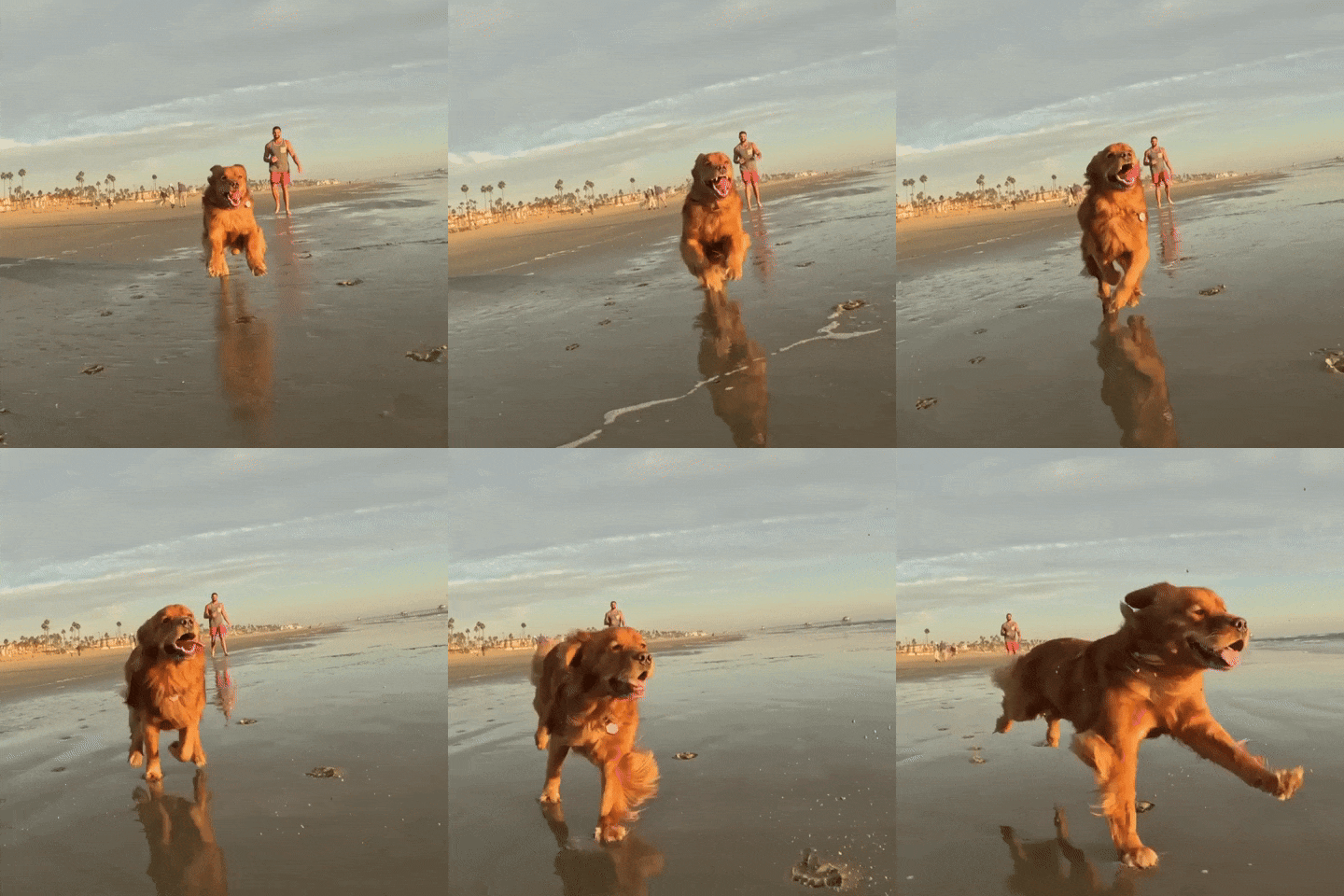
Now, suppose I told you that the farming of dogs for meat in China was not going anywhere anytime soon; in fact, it’s only going to grow in the years to come, and there’s nothing you or anyone else can do about it. But you do have one choice: you could convince every dog farmer in China to replace their current breeds with golden retrievers.
At first, this seems like an abomination: to take beings with so much potential for joy and pack them into the worst imaginable hell feels even more atrocious than doing it to less happy animals.
But slow down, use your thinking brain. The question is not whether a golden retriever will live free or in a farm. The question is whether the dog in a farm will be a golden retriever or a less happy breed. There is not a finite number of golden retrievers; filling China’s farms with them won’t reduce the number of happy ones.
The fact that golden retrievers are so much happier than other dogs in domestic life doesn’t necessarily mean that they’d be happier than other dogs inside of factory farms. But the plan proposed here doesn’t have that problem; we would be designing animals specifically to thrive inside factory farms. Beings utterly devoid of negative affect, for whom every moment lying still in the ammonia-choked air is pure bliss, for whom even the blade cutting into their throat feels like an orgasm. In the limit, maybe these animals would be happier in factory farms than they could be anywhere else.
One severe welfare problem in aquaculture farms is water quality. Fishes and shrimps are packed in so densely that the oxygen levels drop low enough to be toxic, and the sludge of excrement and rotting excess food never gets cleared away. What do you think would happen if an environment like this arose in nature? Well, over a long enough time, some organisms would evolve to thrive on it; they’d adapt to need less oxygen and perhaps even thrive on this water. This exact principle could be used to selectively breed shrimps and fishes who don’t mind the poor water quality. In fact, experiments like this have already happened: give shrimps access to a pool where the oxygen is much higher in some areas than others. Most of the shrimps cluster in the high oxygen areas, but some hang out in the hypoxic areas. Select only those shrimps and soon all their descendants seem indifferent about where in the pool to hang out.
Is this experimental setup vulnerable to Goodharting? As described, absolutely. Maybe all the shrimps prefer oxygen, but some prefer solitude even more. This would perfectly backfire, selecting shrimps who don’t like company for life in densely packed farms. This uncertainty is why going straight to editing on the genetic level is so appealing.
Well, appealing to… whom exactly?
The public will be put in a strange position by the prospect of genetically engineered happy animals. Some people have managed to convince themselves that the animals they eat are already happy; others are genuinely distressed by the violence of meat and must actively try not to think about it when shopping. If we could offer people a future where they could truly eat cheap meat without guilt, would it be enough to overcome the naturalism bias?
Maybe not right away. Public discomfort with genetic engineering was enough to derail golden rice, a cultivar rich in vitamin A that could be preventing 10,000s of children a year from dying in low-income countries and 100,000s more from going blind but has instead been tied up in frivolous lawsuits by Greenpeace.
Public opposition to genetic engineering in food is the strongest reason to think selective breeding might go further than genetic engineering, at least in the short term. You can imagine the headline: Tech bros want to genetically engineer your dinner. Never mind the genetic war crimes already perpetuated against dinner by the biggest meat companies on earth; they didn’t use CRISPR. (If you’re a journalist reading this 17,000-word post to clip viral sentences from, here’s one for you: you really suck, OK?)
Notably, though, this same resistance might not apply to animals not consumed by humans. Hundreds of millions of rats and mice are factory farmed every year for snake food, and insect farming could still take off. Both could be ideal places to prove genetic engineering. And there is a pathway to market if the stakeholders align; the U.S. FDA has already approved genetically engineered strains of salmon and pigs, and Japanese regulators have greenlit a number of CRISPR-edited fish species.
Notice something about that last sentence: you probably haven’t heard anything about it before. The USDA approving, in April 2025, an intervention genetically engineering pigs for resistance to Porcine Reproductive and Respiratory Syndrome was the most significant regulatory decision on genetic engineering in a decade. It generated a quiet buzz in industry trade press, and nowhere else. If it had gone viral and been subsumed into the culture war, it easily could have fallen prey to the cottage industry of MAHA luddite influencers constantly on the prowl to make their follower count go brrr by exposing the latest global elite conspiracy.
The ag industry has no obvious reason to oppose either selective breeding or genetic engineering for welfare as long as neither interferes with productivity or demand. In fact, happy animals could be more docile and cooperative. But an even bigger carrot might be never having to deal with animal activists ever again. And that would be the arrangement: if you get behind this, and let us verify it’s actually working rather than Goodharting, then we will never again run ads against you, show up outside your houses at 2 am with bullhorns, or sneak into your farms to take footage and rescue animals. We’d have no need to. We’ll be the ones most vocally advocating for these innovations when regulators and consumers have questions.
That just leaves animal advocates. Can we bring ourselves to make a deal with the devil? Should we?
It’s OK to feel squeamish about all this. A version of me from even just a year or two ago would have been horrified by all this. I wish I could put my finger on exactly what changed for me; if I could, maybe it wouldn’t have taken so many words to get this far.
Maybe you feel that genetically subjugating animals to our will is an even worse violation on top of subjugating them physically. That it could lock in a morally bleak situation for much longer instead of trying to outright end it.
Or, maybe you think suffering is redemptive, a key part of a meaningful life. You wouldn’t want someone to take away your capacity for complex experiences, to turn you into a passive blob of happy flesh waiting contentedly to be slaughtered.
Maybe your suffering is meaningful, and I wouldn’t try to take it away from you. But this just clearly is not true for animals in factory farms. Even if they had the cognitive ability to do so–and it’s not at all clear that they do–they have no opportunity to transmute their pain into meaning. The right thing for you is not necessarily the right thing for an animal who will only ever exist trapped inside a factory farm, waiting to die.
But if, in the end, you just can’t let go of the sense that this is a violation of some inalienable right to genetic sovereignty, that such a violation is worse than all the torture–and I’m not trying to be snide here, there are coherent moral worldviews in which this is true–if that’s where you land, then I have one last solution I know you’ll love.
Rung 4: Brainless chickens
Let’s not sugarcoat it: we’re talking about chicken bodies (or pigs, fishes, etc) with beating hearts, lungs, nerves, everything. Just no brain. In the place of a brain is a bundle of cables connecting the body to a computer. The computer sends signals to inflate and deflate the lungs, beat the heart, and exercise the muscles that will eventually be sold as meat. The spinal cord is hijacked just before it would reach the brainstem, which does not exist and never existed. Tubes pump food, water, and necessary hormones down the esophagus. The body lies shoulder to shoulder on a rack of identical brainless bodies stretching far as the eye can see in all six directions- which isn’t very far because there is no light in here other than pathogen-killing UVC, and there are no eyes to see and–most importantly–nobody to do the seeing.
Nobody is home inside this factory farm. It is perfectly peaceful. No happiness, no pain, nobody to have their genetic sovereignty violated.
If you were excited about cultivated meat, you have no reason to oppose this. This might just be what cost-competitive cultivated meat production looks like in the end; bioreactors made not of metal, but of skin and bones. Bodies growing like fruits on a mechanical tree. Meat without suffering, engineered in reverse. The technological genie grants our wishes, just not how we expected.
Imagine for a moment that you’re a bullet-biting utilitarian. You chomp down repugnant conclusions for breakfast. You want to fill the universe with happy experiences- as many and as happy as possible. This requires two steps: first, figuring out how to produce happy lives, and second, marshalling resources to do it. You discover a sequence of genes that produces beings who live joyful, euphoric lives in literally any conditions; they simply cannot help but have an amazing time. Excitedly, you rush to publish your paper.
But when the paper comes out, nobody cares. To your immense frustration and confusion, nobody is willing to start spending all of society’s resources manufacturing breeding facilities for your joyful homonculi. You go back to the library and ask Claude:
Hey Claude, how do people manage to get stuff done in society? Like, what gets society to expend resources on some things and not other things?
You’re pretty bright–you just invented a genetic organism from scratch, after all–so you pick up Claude’s economics lesson quickly. You know exactly what to do. You go back, make a few tweaks, and publish your new paper.
This time, you have a sequence of genes that produce happy animals who poop out cheap chicken breast.
You find an investor. With their investment, you build your first happy animal lab. The animals lead joyous lives, equally happy in an open field or stuffed into a drawer, so the most ethical thing is to stuff them all into drawers and make as many as possible. Then, selling the chicken-breast-poop, you fund your second facility. Soon you have a massive, globe-spanning industrial supply chain for producing happy experiences, all funded by consumer demand, and you’re starting to think about interstellar expansion.
Then you hear about a new upstart competitor. Well, you wouldn’t normally think in terms of competition; in your mind, this whole supply chain is about producing happiness, and you’d love for other people to produce even more. But quickly you realize that’s not what this is at all. This new company is trying to undercut your revenue source, without making happy lives. They took the genetic code you had openly published in the hopes others would copy it, and they modified it so that only the body remains. It still poops out chicken breast, but the brain is gone, replaced by a central computer regulating thousands of bodies at once. They’re just in it to make money!
5. Help Wanted
" If thou forbear to deliver them that are drawn unto death, and those that are ready to be slain;" - Proverbs 24:11
Will some process of producing meat without sentience inevitably win out in the end, due to the ruthless optimizations of replication? Should we prefer that over any conceivable form of farming with conscious animals, no matter how happy they are engineered to be? Will consumers ever tolerate columns of fleshy meat-vats plugged into a computer if it looks too much like a scene from the matrix?
Mercifully, I don’t think we need to have answers to these questions right now. We just need to take the next step forward. We in particular need you to do that.
One way to understand where welfare tech and welfare genetics fit into the movement is this grid:
There’s always been sufficient technology for society to stop farming animals if it wanted to. But it doesn’t. So we’ve pushed the industry to adopt low-tech welfare improvements while investing our innovative energy in replacing animals altogether. Until now, we haven’t been investing in technologies that make the next welfare improvements more impactful for animals or easier for the industry to adopt.
That’s finally starting to change.
From the outside, it might seem like the EA wing of the animal advocacy movement goes through fads. That’s because it does. In each cycle, funders get excited about a shiny new object, and put out a call for established organizations and new startup founders to rush into that space by making it clear funding will be available for anyone who does. Vegan leafleting was one such fad, followed by corporate cage-free campaigns, then cultivated meat and alternative proteins in general. Politics is the current fad, and welfare innovation will be the next one.
This can be frustrating for people working on an intervention that never gets popular. But that doesn’t mean it’s actually suboptimal. Some of our fads have worked out, and others haven’t; so it goes.
Animal advocates have limited resources, both money and people, spread thin across researchers, campaigners, and grantmakers. It’s probably the case that we needed to put all of our spare energy into cage-free campaigning to get the ball rolling there, and indeed, while the cage-free fight has been a big success, it’s hardly over despite all the energy invested. I’m glad that increasing our political capacity has been a major influence for the last few years and that it will continue to get attention.
But I’m also glad that there’s about to be a major infusion of money and attention into welfare innovation. And because of that, it’s quickly becoming clear that the pace of this innovation will be limited not by funding, but by talent. That’s where you come in.
Start/join a startup
Perhaps the most impactful thing you could do is start a new startup and become the animal movement’s point person on one or more specific technological innovations.
But Aidan, I hear you say, I ’m not a mechanical engineer or anything like that. I got my bachelor’s degree in Medieval Studies, with a minor in Puppetry. How am I supposed to start a tech company?
Be not afraid, dear reader. While technical skills would go a long way, not all founders need to be technical. First, there are many technologies that we’ve already pretty much developed, for which the task is now to get them adopted across the industry; that’s a more versatile strategy role.
Second, most of your role as a founder is to communicate a clear vision for your startup, recruit the right people, and get them the resources they need to succeed. You could recruit technical talent from outside the movement if you can demonstrate to funders that you have what it takes to lead.
Third, there has never been a better time to quickly teach yourself skills- and by teach yourself, I mean have ChatGPT or Claude teach you. Anyone willing to learn to use AI agents now has the power of a mediocre software engineer, and with a surprisingly small amount of elbow grease you can become dangerous. Learning mechanical engineering would be a bit steeper for sure, but you can at least teach yourself enough to get by and even to prototype. As Paul Graham says:
If that still sounds scary, there are people whose job it is to help you.
Spring Innovation Fund is a new “not-for-profit venture philanthropy studio and fund built specifically for Welfare Tech,” basically an incubator where you can get expert coaching and seed funding to launch your startup. They have separate tracks for engineers/builders vs. ideators/entrepreneurs, with competitive salaries for the former and up to $500,000 in seed funding for the latter. Learn more and express interest here.
Ambitious Impact (formerly Charity Entrepreneurship) is a longstanding accelerator for high-impact charities. They’re pros and literally wrote the book. AIM has incubated many animal charities in the past, but next year they’re launching their first cohort entirely dedicated to animal welfare, with a focus on welfare innovation. Like Spring, AIM offers an intensive coaching program, cofounders, and seed funding. Learn more and apply here by September 13.
If you want to join an existing organization working in this space, email me and I can share some other high impact opportunities.
Donate
If you’re looking to make a large donation into this space, get in touch and I can point you in the right direction.
Accelerate adoption
What if you’re part of an existing animal advocacy org that isn’t well suited to research? There’s a role for you too, but it will require a greater degree of self-examination.
6. Hope doesn’t replicate
" Can two walk together, except they be agreed?" - Amos 3:3
The most powerful recurring theme in welfare innovation is that there are numerous interventions where the desires of advocates and the industry align, and it is the public or regulators who need to be educated and brought onboard. This is where campaigners can thrive. We can partner with the industry to educate doubters about the need for easy welfare wins like vaccines and high-welfare breeds.
To realize the full potential of technology and genetics for welfare, we’ll need to shift the way we think about friend and foe.
Way back in section 2, I admitted that we can’t know for sure how much impact the meme of animal rights has had on the world. Maybe without it, factory farming would have grown even faster and been even more cruel.
But could it have been net negative? Lately I’ve been wondering what the world might look like if animal advocates and factory farmers had never wound up in an adversarial posture. There’s no question they started it by torturing animals, and I’m grateful that there were people from the beginning standing up and speaking out against it. But what if activism had never put farmers on the defensive, causing them to dig their heels in against even the smallest welfare improvements? Maybe a movement that never conceived of the notion of “animal rights” would have, perversely, achieved more by now, getting more farms to adopt things like cage-free barns and slow-growing chicken breeds.
This isn’t just about some nonexistent past. Opportunities are blossoming now to change how we relate to people who hold the fates of billions of animals in their hands.
Many readers might imagine forming partnerships with the industry in order to develop welfare innovation as a sort of “infiltration,” trying to pull one over on unsuspecting farmers. But it doesn’t have to be like that, and it probably shouldn’t be.
A few weeks ago, I shared this anecdote about a stump speech Paul Shapiro used to give to fiery animal activists. He starts by asking:
How far would you go to achieve animal liberation?
[The crowd cheers.]
Would you do whatever it takes?
Yes! [comes the reply.]
Would you break the law?
[They respond even louder] yes!
Would you go to prison for animals?
Yes!! [It’s fewer voices, but more emphatic.]
Banging his fist on the table: Would you give your life for animals if that’s what it took to win?
Yes! [They scream out in religious fervor!]
[Grabbing the podium like a Baptist preacher, voice thundering out across the crowd]: Alright then. Would you get a hair cut, put on a suit, and go schedule meetings with politicians and corporate boards of directors?
[Quiet murmurs spread across the room as the activists exchange confused looks with one another.]
There’s a version of this dynamic (not with Paul) that I’ve been part of, backstage, after hours, that takes on a darker note, with activists signaling how committed they are to the cause by describing the Machiavellian lengths we would go to if it would help animals. It’s no wonder factory farmers are paranoid about our intentions.
So let me tell you the moment in the last year, maybe in the last ten, where I have felt the most intense respect for an animal advocate, sensed most profoundly the depth of their conviction. It was when a longtime vegan told me they were thinking of starting a factory farm.
It wasn’t a boast, or a naughty secret. It was spoken softly, in the tone of someone about to set out on a secret mission from which they might never return alive. In that instant I knew that if they followed through with it, it would haunt their sleep for the rest of their life. But the vision was worth it: if they could get ahead of the industry, build the new AI-powered farming paradigm that can undercut even the most ruthless factory farms of today, they could shape it to be as good for animals as possible. Success would look like becoming the largest ag company in the world.
Every day, they would hope for cultivated meat to finally arrive, to undercut their product and drive them out of business. But hope doesn’t replicate.
Of course, even if they tried doing this, it probably wouldn’t work out. The baseline probability that your vegan friend is going to become the world’s greatest chicken breast kingpin is low. But what if we didn’t need the chicken farming executives to come from the vegan movement in order to have that kind of relationship with them?
While I was researching this post, I mentioned it to my friend Becca Rogers from New Roots Institute. New Roots doesn’t work on welfare practices directly, so I was surprised when she started rattling off facts I hadn’t heard about how quickly the pork industry in the U.S. is embracing AI. As it turns out, she spends her free time listening to industry podcasts.
I was impressed, even embarrassed; I’ve had the thought before that I should be listening to factory farmers in their own words, as a “know thy enemy” sort of thing. But I could never bring myself to do it. The thought of listening to friendly bumpkins casually chat about torturing animals was too much.
Then I realized that Becca wasn’t thinking of this as infiltration. Yes, farmers’ interests sometimes clash with ours, and when they do we fight for what we want. But if we accept a narrative that sets us invariably at odds, then animals will pay the price for the missed opportunities when our interests could in fact align.
In the height of the Cold War, while they were waging full-on kinetic proxy wars across a dozen countries, the United States and the Soviet Union carried out one of the most complex intergovernmental efforts in history to eradicate smallpox, successfully bringing down the curtain on a disease that claimed 300 million lives in the 20th century, far more than every war combined. The Soviets proposed the program and donated over a billion doses of vaccine; the Americans bankrolled it and led the campaign in the field. The last naturally occurring case was documented and contained inside an active proxy warzone in Somalia. If either country had thumbed its nose at cooperation, they would have wasted countless lives and billions of dollars for no gain.
If that was a one-time miracle, the same dynamic maintains every day between labor unions and large corporate employers. Unions exist primarily to counteract the power of employers, but both sides take their interests too seriously to fail to set their differences aside when those interests align. When foreign competition or new regulations threaten the position of their industry as a whole, labor unions and employer associations fly into D.C. in lockstep. They spend at least as much time cooperating on lobbying and more prosaic tasks like running apprenticeships and co-managing pension funds than they do butting heads in contract negotiations.
When I listened to Becca’s podcast recommendations without assuming hostility, I was surprised how easy it was to imagine myself relating to these farmers in the same way, walking through a farm together inspecting newly-installed welfare equipment, negotiating on the same side of the table as often as on opposite sides. And I could imagine those negotiations leading to bigger wins for animals than anything we’ve achieved thus far.
Can you imagine a world where factory farmers don’t need to be our enemies? Can you imagine how much more influence we could exercise over animals’ lives if we were partners rather than foes?
Can you bring yourself not just to imagine it, but to yearn for it?
Build on,
Sandcastles
Easter egg
Regular readers might be interested to know: this article was a step change for me in terms of how I worked with AI. I’ve used Claude to find numbers and citations for me before, but this time Fable spontaneously took a more editorial role, pushing back on lazy rhetoric and suggesting nuanced ways that I could better align my load-bearing arguments with the empirical facts. I imagine this is what it would feel like to work with a professional editor, though I’ve never had that privilege. Only two or three clauses were Claude’s input verbatim, so I expect none of the text to return a positive on Pangram, but writing sentences is the easy part; the contributions Claude did make were more important. If Sandcastles were a newspaper, this is the first piece where I think Claude would have earned a byline. I’m thinking about how to properly acknowledge that in future posts.
This wasn’t long enough for you? Then don’t miss the next one.
Seriously though, I’d really appreciate it if you share this post with someone who might change the course of their advocacy as a result.